
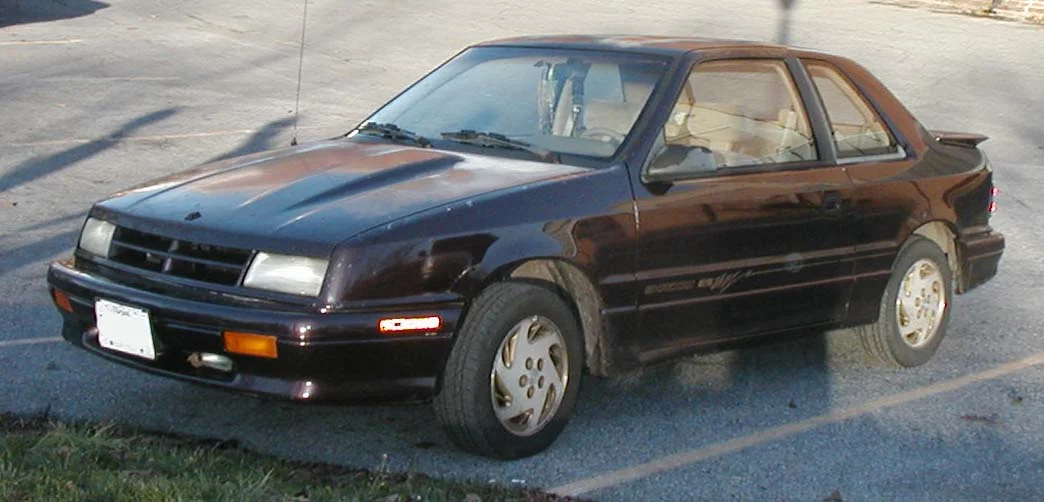
Brief Introduction of Dodge Shadow
The Dodge Shadow is a compact car that was produced by the Chrysler Corporation from the 1987 to 1994 model years. It was introduced as a replacement for the Dodge Omni and Dodge Charger. The Shadow was available in several body styles, including a 3-door hatchback, a 5-door hatchback, and a 2-door convertible, which was added in 1991. Marketed as an economical and practical choice, the Shadow, along with its Plymouth counterpart, the Sundance, offered a surprising amount of versatility with its “hidden hatchback” design. Though it had a relatively short production run, the Dodge Shadow went through various updates and was available in multiple trim levels and with a range of engine options, from economical four-cylinders to turbocharged and V6 variants, making it a noteworthy vehicle in Dodge’s history. Production of the Dodge Shadow ceased in March 1994, with the introduction of the Dodge Neon.

Dodge Shadow Overview
| Brand | Dodge (Chrysler Corporation) |
| Model | Shadow |
| Launch Year | 1987 |
| Price | Original MSRP ranged from approximately $7,992 to $16,109 depending on year and trim |
| Variants | Base, America/S, Highline, ES |
| Body Type | 3-door hatchback, 5-door hatchback, 2-door convertible |
| Engine | 2.2L K I4, 2.2L Turbo I/IV I4, 2.5L K I4, 2.5L Turbo I I4, 3.0L Mitsubishi 6G72 V6 |
| Power & Torque | 93 hp – 174 hp; 122 lb-ft – 210 lb-ft |
| Transmission | 5-speed manual, 3-speed automatic, 4-speed automatic |
| Fuel Type | Gasoline |
| Mileage | Combined MPG ranged from 19 to 25 depending on engine and transmission |
| Colors | Black, Bright White, Colorado Red, Claret Red Pearl Metallic, Raspberry Red Pearl Metallic, Sterling Silver Metallic, Dark Silver Metallic, Platinum Silver Metallic, Diamond Blue Metallic, Midnight Blue Metallic, Black Cherry Pearl Metallic |
| Safety Rating | 1991-1993 NHTSA Frontal Crash Test: Not fully tested, but received a 4-star rating for the driver side in some tests. No side-mounted or head airbags were available. |
| Dimensions | Wheelbase: 97.0–97.2 in, Length: 171.7–171.9 in, Width: 67.3 in, Height: 52.6–53.1 in |
| Boot Space | Approximately 13.2 to 30.8 cubic feet |
Generations and History of Dodge Shadow
First Generation (1987-1994)
The Dodge Shadow was built on a variant of the Chrysler K-car platform, known as the P-body. This platform combined the suspension from the Dodge Daytona with a shortened body from the Dodge Lancer. The initial offerings were 3-door and 5-door hatchbacks, designed to look like a coupe and sedan, a feature Chrysler marketed as “hidden hatchback versatility.” The first Shadows rolled off the assembly line on August 25, 1986, for the 1987 model year. Engine choices at launch included a 2.2L inline-four and a turbocharged version for the sportier ES trim. A 2.5L four-cylinder was also available. The base engine was tuned for torque, providing a different driving feel compared to competitors like the Honda Civic. The Shadow was positioned as a more substantial offering in the economy segment, competing with the likes of the Ford Escort and Chevrolet Cavalier.
Dodge Shadow Facelifts and Yearly Updates
| Year | Change / Update |
| 1989 | Cosmetic updates including new composite headlamps, a refreshed grille, and new taillights. |
| 1990 | A driver’s side airbag became standard on all U.S. models. The 5-speed manual transmission was modified for easier shifting into reverse. A new 2.2L VNT Turbo IV engine became available. |
| 1991 | The 2-door convertible model was introduced. The base trim was split into the entry-level “America” and the mid-level “Highline.” |
| 1992 | A 3.0L Mitsubishi-built V6 engine was introduced as an option, replacing the turbocharged engines. The Plymouth Sundance variant received a “Duster” trim. |
| 1993 | A Bendix-4 anti-lock braking system (ABS) became available as an option. The trim lineup was modified with the “base” model returning. |
| 1994 | To comply with federal safety standards, motorized passive shoulder belts were added for front occupants. The air conditioning system was updated to use CFC-free refrigerant. |
Dodge Shadow Variants and Features
The Dodge Shadow was offered in several trim levels throughout its production. The initial trims were a base model and the sportier ES. In 1991, the lineup was expanded to include the budget-friendly “America” or “S” (in Canada) and the “Highline” trim. The ES variant often featured a sport suspension and more powerful engine options. The convertible was available in Highline and ES trims. Available features, depending on the year and trim, included power windows, power mirrors, power door locks, cruise control, a tilt steering wheel, and an overhead console with map lights. An upgraded instrument cluster with a tachometer and a “light package” were also available. For entertainment, an Infinity sound system could be optioned.
Dodge Shadow Engine, Performance, and Driving Experience
The Dodge Shadow offered a range of engines to suit different driving preferences. The base engine was a 2.2L four-cylinder that produced around 93 horsepower. A larger 2.5L four-cylinder was also available, offering slightly more power and smoother performance. For those seeking more power, several turbocharged 2.2L and 2.5L engines were offered in the earlier years, with horsepower figures reaching up to 174 hp in the special Shelby CSX models. The turbocharged engines provided swift acceleration but were known for being noisy. In 1992, a 3.0L Mitsubishi V6 producing 141 horsepower was introduced, replacing the turbo-four options. This V6 was smoother and provided a frisky performance, especially when paired with a manual transmission. Transmission options included a 5-speed manual, a 3-speed automatic for the four-cylinder engines, and a 4-speed automatic for the V6. The ride and handling were considered competent for its class.
Dodge Shadow Pricing and Mileage
When new, the Dodge Shadow was positioned as an affordable compact car. Original Manufacturer’s Suggested Retail Prices (MSRP) for a 1993 model, for instance, ranged from $8,847 to $14,247, depending on the trim and options. For the final 1994 model year, the MSRP started at $9,206 and went up to $13,649. In terms of fuel economy, the Shadow delivered respectable numbers for its era. A 1994 model with the base 2.2L engine and manual transmission could achieve an estimated 21 MPG in the city and 27 MPG on the highway. The V6-equipped models had slightly lower fuel efficiency, with ratings around 19 MPG city and 25 MPG highway. Owner reviews have mentioned achieving up to 33 miles per gallon on the highway with the five-speed manual transmission.
Dodge Shadow Colors, Design, and Dimensions
The Dodge Shadow featured a design that was contemporary for the late 1980s and early 1990s. While appearing as a traditional sedan or coupe, its hatchback design offered enhanced cargo versatility. Exterior color options included a range of metallic and pearl coat finishes such as Diamond Blue Metallic, Black Cherry Pearl Metallic, Sterling Silver Metallic, and Raspberry Red Pearl Metallic, in addition to standard colors like Black and Bright White. The dimensions of the Shadow placed it firmly in the compact segment. Its wheelbase was approximately 97 inches, with an overall length of about 171 inches. The width was 67.3 inches, and the height varied slightly by model year, hovering around 53 inches. The curb weight of the vehicle ranged from roughly 2,600 to 2,900 pounds depending on the body style and equipment.
Dodge Shadow Safety Features
- Airbags: A driver-side airbag was made standard on all U.S. models starting in 1990.
- ABS / EBD: A low-pressure Bendix-4 anti-lock braking system (ABS) was available as an option from 1993 onwards.
- Electronic Stability Control: This feature was not available on the Dodge Shadow.
- Crash Test Ratings: The Dodge Shadow received a notable 4-star driver and 5-star passenger rating in frontal crash tests for its time.
- Other advanced safety systems: For the 1994 model year, motorized passive front seatbelts were added to comply with U.S. federal safety standards.
Dodge Shadow Infotainment and Connectivity
As a vehicle from the late 1980s and early 1990s, the infotainment and connectivity options in the Dodge Shadow were basic by modern standards. The standard audio system was an AM/FM stereo with a clock. An upgraded Infinity sound system was available as an option. Some models also offered a cassette player. Advanced features like touchscreens, Apple CarPlay, Android Auto, navigation, and Bluetooth were not available during the Shadow’s production run.
Dodge Shadow Owner Reviews & Ratings
Owners of the Dodge Shadow have generally given the car positive reviews, with many praising its reliability and value for money. The car is often remembered as a dependable first car or a practical family vehicle. Common points of praise include its surprising durability, with some owners reporting high mileage with minimal major issues. The V6 engine is often highlighted for its peppy performance. Some of the common complaints are related to electrical issues and transmission problems, particularly with the automatic transmissions of that era. Overall, the Shadow has a reputation for being a solid and economical car, with many owners expressing a fondness for its simplicity and practicality.

Dodge Shadow Comparison with Similar Cars
The Dodge Shadow competed in a crowded compact car segment against vehicles like the Ford Escort, Chevrolet Cavalier, Honda Civic, and Toyota Corolla. Compared to its domestic rivals, the Shadow and its Plymouth Sundance sibling were often seen as solid, affordable alternatives. Against its Japanese competitors, the Shadow was sometimes considered less refined. However, the Shadow offered a “hidden hatchback” versatility that gave it a cargo-carrying advantage over traditional sedans. The availability of turbocharged and V6 engines also gave the Shadow a performance edge over the base models of many of its competitors.
Dodge Shadow Awards and Recognition
Information not publicly available.
Interesting Facts about Dodge Shadow
- A high-performance version of the Shadow, the Shelby CSX, was created by Carroll Shelby. The CSX featured a turbocharged 2.2L engine producing up to 174 horsepower. A special version, the CSX-VNT, utilized a variable-nozzle turbocharger to reduce turbo lag.
- A rental-only version, the CSX-T, was produced for the Thrifty rental car company.
- The Dodge Shadow was also sold in Europe from 1988 to 1991 as the Chrysler ES.
- The convertible version of the Shadow was built by having the coupes converted by the American Sunroof Company.
Dodge Shadow Legacy and Influence
The Dodge Shadow and its sibling, the Plymouth Sundance, played a significant role in Chrysler’s lineup during their production run. They served as the brand’s entry-level compact offerings, appealing to a wide range of buyers with their affordability and practicality. Although they were based on the aging K-car platform, they were popular models for Chrysler. The Shadow’s “hidden hatchback” design was an innovative approach to combining the aesthetics of a sedan with the utility of a hatchback. The introduction of a standard driver-side airbag in 1990 was a significant safety advancement for a car in its class at the time. Ultimately, the Shadow and Sundance were replaced by the Dodge and Plymouth Neon, which continued to build on the concept of a fun-to-drive and affordable compact car.
Dodge Shadow Global Availability
The Dodge Shadow was primarily manufactured and sold in North America. The main production facilities were in Sterling Heights, Michigan, and Toluca, Mexico. In Mexico, the car was marketed as the Chrysler Shadow. As mentioned, the Dodge Shadow was also exported to Europe between 1988 and 1991, where it was sold as the Chrysler ES. These models were available as a 3-door hatchback with either a naturally aspirated or turbocharged 2.2L engine, later replaced by a 2.5L unit.
Dodge Shadow Maintenance and Ownership Costs
The Dodge Shadow was generally considered an inexpensive car to own and maintain. Its mechanical components, being based on the widely used K-car platform, were readily available and relatively affordable. Routine maintenance costs were in line with other economy cars of its time. Some owners have reported spending around $1,000 every 18 months on regular maintenance to keep the car in top condition as it aged. Common issues that could arise with higher mileage included oil leaks, head gasket failure, and problems with the automatic transmission. However, many owners have also reported their Shadows to be very reliable with proper care.
Final Words about Dodge Shadow
The Dodge Shadow holds a unique place in automotive history as a practical and versatile compact car of the late 1980s and early 1990s. While it may not have had the same level of refinement as some of its international competitors, it offered a compelling package of affordability, utility, and, in some trims, spirited performance. Its “hidden hatchback” design was a clever feature that set it apart, and its early adoption of a standard driver-side airbag was a commendable safety initiative. For those seeking a nostalgic look at a bygone era of straightforward and honest transportation, the Dodge Shadow remains a memorable and significant model in the Dodge lineage. It successfully bridged the gap between the older Omni/Horizon and the newer Neon, leaving a legacy of value and practicality.