
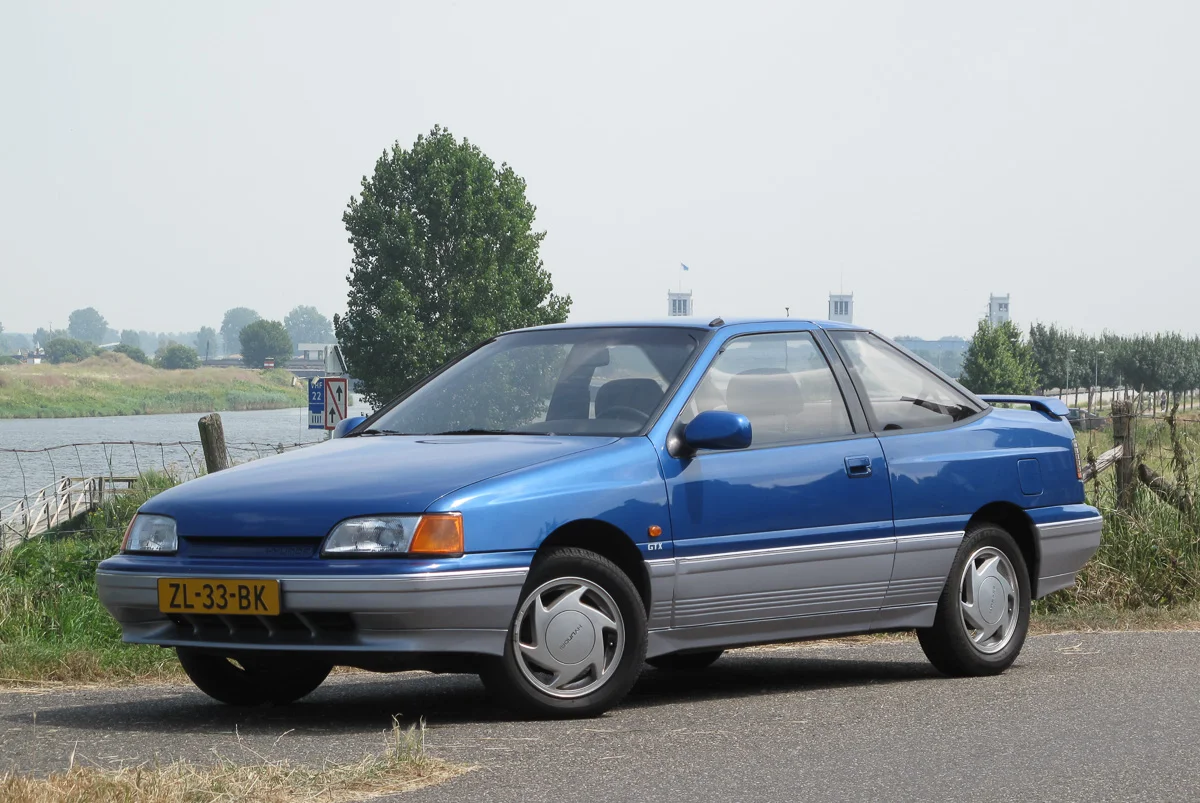
Brief Introduction of Hyundai Scoupe
The Hyundai Scoupe, a portmanteau of “sporty” and “coupe,” was a compact sports coupe produced by the South Korean automaker Hyundai from 1990 to 1995. As Hyundai’s first foray into the sports car market, the Scoupe was developed to be an affordable and stylish option for younger buyers, competing with the likes of the Honda Civic and Nissan Pulsar NX. Based on the Hyundai Excel’s platform, it was a 2-door coupe that offered a blend of economy and sporty aesthetics. Over its production run, the Scoupe saw one major generation with a significant facelift, and it was available in several variants, including a noteworthy turbocharged model that showcased Hyundai’s growing engineering capabilities. Its affordability and distinctive styling made it a notable vehicle in Hyundai’s history as the company expanded its global presence.

Hyundai Scoupe Overview
| Brand | Hyundai |
| Model | Scoupe |
| Launch Year | 1990 |
| Price | Original MSRP started at $8,495 (1991 US market) |
| Variants | Base, LS, GT (Turbo) |
| Body Type | 2-door Coupe |
| Engine | 1.5L Mitsubishi-sourced I4, 1.5L Hyundai Alpha I4, 1.5L Hyundai Alpha Turbo I4 |
| Power & Torque | 81-115 hp, 91-123 lb-ft of torque |
| Transmission | 5-speed manual, 4-speed automatic |
| Fuel Type | Gasoline |
| Mileage | Approximately 23-34 MPG (city/highway, depending on model and transmission) |
| Colors | Information not publicly available |
| Safety Rating | NHTSA: 4 out of 5 stars for front-side driver and passenger crash tests (1992-1995 models) |
| Dimensions | Wheelbase: 2,385 mm, Length: 4,215 mm, Width: 1,625 mm, Height: 1,330 mm |
| Boot Space | 9.3 cu ft |
Generations and History of Hyundai Scoupe
First Generation (1990-1995)
The development of what would become the Hyundai Scoupe began in 1985. A prototype, named the “Sports-looking Car” (SLC) concept, was exhibited at the 1989 Tokyo Motor Show. Regular production of the Scoupe commenced in February 1990. The car was based on the contemporary Hyundai Excel, sharing its platform and underpinnings. Initially, the Scoupe was powered by an 81-horsepower, 1.5-liter Mitsubishi-sourced inline-four engine. This engine was paired with either a 5-speed manual or a 4-speed automatic transmission. The design was a joint effort, with some credit given to Italdesign Giugiaro, although it was primarily an in-house project. The initial design featured a boxy yet sleek profile for its era, aiming to capture the sporty aesthetic of the early 90s.
Facelifted Generation (1993-1995)
In 1993, the Scoupe received a significant facelift which included a redesigned front end with sleeker, more rounded headlights and a new grille, giving it a more modern and aggressive appearance. The rear of the car also saw updates with new taillights. A major update under the hood came with the introduction of Hyundai’s own “Alpha” 1.5-liter engine, replacing the Mitsubishi unit. This new engine came in two versions: a naturally aspirated model producing 92 horsepower and a turbocharged version, the Scoupe GT, which delivered 115 horsepower. The turbocharged model was a significant milestone for Hyundai, as it featured South Korea’s first domestically designed and produced engine with a turbocharger. The facelifted models with the new Alpha engine represented Hyundai’s growing independence and technological advancement in powertrain development.
Hyundai Scoupe Facelifts and Yearly Updates
| Year | Change / Update |
| 1991 | The Mitsubishi-sourced 1.5L engine was replaced by Hyundai’s own 1.5L Alpha engine in April. |
| 1993 | A major facelift was introduced, featuring a redesigned front fascia with sleeker headlights and a new grille. The rear also received updated taillights. The turbocharged “GT” or “LS Turbo” variant was introduced, featuring the 1.5L Alpha Turbo I4 engine. |
Hyundai Scoupe Variants and Features
The Hyundai Scoupe was offered in a few key variants throughout its production. The base model and the LS trim were equipped with the naturally aspirated engine. Standard features were modest, reflecting the car’s budget-friendly positioning, but often included amenities like a tachometer, which was a sporty touch for the segment. The interior was functional, with a dashboard that curved towards the driver. The top-tier variant was the Scoupe GT, known as the LS Turbo in the US market, which was introduced with the 1993 facelift. This model was powered by Hyundai’s first in-house developed turbocharged engine, significantly boosting performance. The Turbo models were only available with a 5-speed manual transmission. Visually, the Turbo variant could be distinguished by unique styling cues, such as a black roof and “turbo” lettering on the rocker sills. Safety features were limited for the era; for instance, the Scoupe was one of the last cars sold in the US with motorized seat belts instead of airbags.
Hyundai Scoupe Engine, Performance, and Driving Experience
The initial Hyundai Scoupe was equipped with a 1.5-liter Mitsubishi 4G15 inline-four engine, which produced 81 horsepower. While not powerful, it provided adequate performance for a lightweight coupe. The driving experience was geared more towards comfort and economy than outright sportiness. With the introduction of Hyundai’s own Alpha engine in 1991, the naturally aspirated version saw a power increase to 92 horsepower. The real game-changer was the turbocharged Alpha engine introduced in 1993, which produced 115 horsepower and 123 lb-ft of torque. This engine made the Scoupe a much more spirited performer, with a 0-60 mph time of around 9.2 seconds. The suspension was independent with MacPherson struts at the front and a trailing arm setup in the rear, which was a decent configuration for a car in its class, offering a reasonable balance of handling and ride comfort. The handling was considered competent, though not as sharp as some of its Japanese rivals.
Hyundai Scoupe Pricing and Mileage
The Hyundai Scoupe was launched in the United States for the 1991 model year with a base price of $8,495, making it a very affordable sporty coupe. Even the top-of-the-line turbocharged model, introduced later, remained competitively priced. For example, in 1993, the Scoupe Turbo had a starting MSRP of $10,999. In terms of fuel economy, the naturally aspirated models with a manual transmission achieved EPA ratings of around 26 mpg in the city and 34 mpg on the highway. The automatic transmission versions were slightly less efficient. The turbocharged variant offered a good balance of performance and economy, with an estimated combined MPG of around 26-27. Due to its simple mechanicals, maintenance costs for the Scoupe were generally low, adding to its appeal as a budget-friendly vehicle.
Hyundai Scoupe Colors, Design, and Dimensions
The exterior design of the Hyundai Scoupe was one of its main selling points. The initial models had a more angular, wedge-like shape, characteristic of the late 1980s and early 1990s. The 1993 facelift brought a more rounded and aerodynamic look, which was well-received. While a comprehensive list of original color options is not readily available, they were typical for the era, including a range of solid and metallic finishes. The interior was designed to be driver-focused, with a wraparound dashboard. The materials were in line with its budget price point, with a lot of hard plastics. In terms of dimensions, the Scoupe was a compact car, with a wheelbase of 2,385 mm, an overall length of 4,215 mm, a width of 1,625 mm, and a height of 1,330 mm. These compact dimensions contributed to its nimble handling and made it easy to drive in urban environments.
Hyundai Scoupe Safety Features
- Airbags: Airbags were not available on the Hyundai Scoupe; it utilized motorized seat belts in the US market.
- ABS / EBD: Anti-lock brakes were not offered on the Scoupe.
- Electronic Stability Control: This technology was not available on vehicles of this era and class.
- Crash Test Ratings: The National Highway Traffic Safety Administration (NHTSA) gave the 1992-1995 Scoupe models a 4 out of 5-star rating for both driver and passenger side frontal crash tests.
- Other advanced safety systems: The Scoupe did not feature any advanced safety systems.
Hyundai Scoupe Infotainment and Connectivity
The infotainment and connectivity options in the Hyundai Scoupe were basic, even for its time. The standard audio system typically consisted of an AM/FM radio and a cassette player. A CD player was available as an option or on higher trim levels in later models. There were no advanced connectivity features like Bluetooth or navigation, as these technologies were not common in mainstream vehicles during the Scoupe’s production years. The focus was on providing fundamental entertainment options at an affordable price point.

Hyundai Scoupe Owner Reviews & Ratings
Owner reviews for the Hyundai Scoupe are mixed, which is typical for a budget-oriented car of its age. Many owners praised its stylish looks for the time, affordability, and decent fuel economy. The turbocharged model was often highlighted for its fun-to-drive nature. However, there were also common complaints regarding reliability, particularly with the transmission and electrical components in some cases. Build quality was another point of criticism, with some owners experiencing rattles and issues with interior trim. Despite these issues, a significant number of owners have reported positive experiences, with some cars lasting for high mileage with proper maintenance. Overall, the Scoupe is often remembered fondly as a first car for many, offering a sporty look and feel without a high price tag or running costs.
Hyundai Scoupe Comparison with Similar Cars
During its time, the Hyundai Scoupe competed in the crowded and competitive compact coupe market. Its main rivals included the Honda Civic Coupe, Nissan 100NX (Sentra SE-R in some markets), and the Geo Storm. Compared to these competitors, the Scoupe’s primary advantage was its lower price. In terms of performance, the base Scoupe was generally outmatched by its rivals, but the turbocharged model offered competitive acceleration. However, in aspects like handling, refinement, and overall build quality, the Scoupe was often considered to be a step behind its Japanese counterparts. The Honda Civic, in particular, was praised for its superior engineering, reliability, and driving dynamics. The Nissan 100NX was known for its T-top roof and the powerful SR20DE engine in its top trim. While the Scoupe offered a compelling value proposition, it struggled to match the overall package of its more established competitors.
Hyundai Scoupe Awards and Recognition
- In 1992, a modified Hyundai Scoupe Turbo won its class at the Pikes Peak International Hill Climb, driven by Rod Millen, setting a new record for the Showroom Stock class.
Interesting Facts about Hyundai Scoupe
- The name “Scoupe” is a combination of the words “sporty” and “coupe.”
- The Scoupe was the first Hyundai vehicle to be fitted with a three-way catalyst.
- It was South Korea’s first domestically designed and produced sports coupe.
- The introduction of the turbocharged Alpha engine in the Scoupe marked a significant step for Hyundai in developing its own powertrain technology.
- A total of 242,441 Scoupes were produced, with 178,443 of them being for export markets.
Hyundai Scoupe Legacy and Influence
The Hyundai Scoupe played a crucial role in the evolution of the Hyundai brand. It was an early and important step in moving the company’s image from just a builder of cheap, economy cars to a manufacturer capable of producing more exciting and desirable vehicles. While it may not have been a huge commercial success compared to some of its rivals, it laid the groundwork for future Hyundai sports coupes like the Tiburon and the Genesis Coupe. The experience gained from developing and marketing the Scoupe, especially the turbocharged model, helped Hyundai build its engineering expertise and brand reputation. Today, the Scoupe is a rare sight on the roads, but it holds a significant place in Hyundai’s history as a symbol of the company’s early ambitions in the sports car segment.
Hyundai Scoupe Global Availability
The Hyundai Scoupe was produced at Hyundai’s Ulsan plant in South Korea. While it was sold in its domestic market, a large portion of its production was for export. The Scoupe was available in North America, Europe, and other international markets. It was an important model for Hyundai’s global expansion in the early 1990s. The specifications and trim levels could vary between different markets to suit local regulations and consumer preferences. For example, in the US, the top-tier turbocharged model was known as the LS Turbo, while in other markets it was badged as the GT.
Hyundai Scoupe Maintenance and Ownership Costs
Ownership costs for a Hyundai Scoupe today are influenced by its age. As a classic or enthusiast car, finding parts can be a challenge. However, when it was new and for many years after, its maintenance costs were relatively low. Many of its mechanical components were shared with the high-volume Hyundai Excel, which helped with parts availability and affordability. The engines, both the Mitsubishi-sourced and the Hyundai Alpha units, are known to be fairly reliable if well-maintained. Common issues reported by owners over the years include transmission problems, electrical gremlins, and rust in areas with harsh climates. The resale value of the Scoupe is quite low, which makes it an inexpensive entry into classic car ownership, but also means that owners are unlikely to see a return on their investment in repairs and restoration.
Final Words about Hyundai Scoupe
The Hyundai Scoupe was a significant car for the Hyundai brand, representing its bold entry into the competitive sports coupe market of the early 1990s. While it may not have been the most refined or powerful car in its class, it offered a stylish and sporty package at an unbeatable price. The introduction of the facelifted model with Hyundai’s own turbocharged engine was a testament to the company’s rapid technological progress. For buyers at the time, the Scoupe was an attractive option for those who wanted a fun and affordable car with a bit of flair. Today, it stands as a nostalgic piece of Hyundai’s history, a car that paved the way for the more sophisticated and performance-oriented vehicles that the brand produces now. It’s a reminder of how far Hyundai has come and a quirky, interesting classic in its own right.