
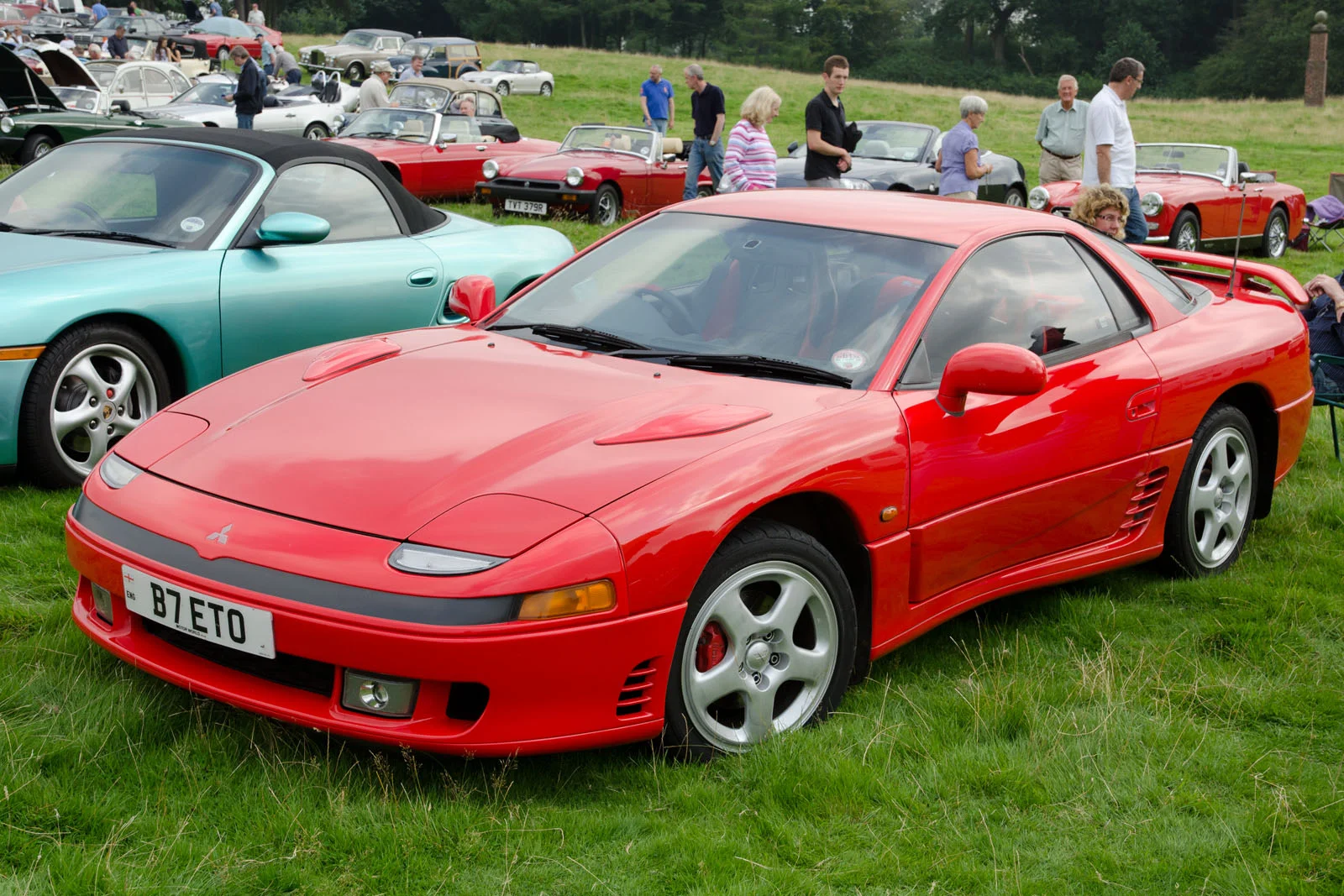
Brief Introduction of Mitsubishi 3000GT
The Mitsubishi 3000GT is a grand touring sports car that was manufactured and marketed by the Japanese automaker Mitsubishi from 1990 to 2000. Known in its home market as the GTO, this 2+2 four-seater coupe was a showcase of Mitsubishi’s advanced technology for its time. It was developed as a successor to the Mitsubishi Starion and was designed to compete with other Japanese sports cars of the era like the Toyota Supra and Nissan 300ZX. The 3000GT is noteworthy for its sophisticated features, which on various models included full-time all-wheel drive, four-wheel steering, active aerodynamics with automatically adjusting front and rear spoilers, an electronically controlled suspension, and a tunable exhaust. It was offered in several variants across its single generation, which received multiple facelifts and updates throughout its production run.

Mitsubishi 3000GT Overview
| Brand | Mitsubishi |
| Model | 3000GT |
| Launch Year | 1990 |
| Price | Original MSRP varied by trim; current used prices range widely based on condition and variant. |
| Variants | Base, SL, VR-4, Spyder SL, Spyder VR-4 |
| Body Type | 2-door liftback coupé, 2-door convertible |
| Engine | 3.0L SOHC V6, 3.0L DOHC V6, 3.0L DOHC twin-turbocharged V6 |
| Power & Torque | 161 hp to 320 hp, Torque varied by engine |
| Transmission | 5-speed manual, 6-speed manual, 4-speed automatic |
| Fuel Type | Gasoline |
| Mileage | City MPG ranged from 15 to 19, Highway MPG from 22 to 25 depending on the model and year. |
| Colors | Various, including red, black, white pearl, and green pearl for Spyder models. |
| Safety Rating | Not officially rated by modern standards. |
| Dimensions | Wheelbase: 2,470 mm (97.2 in), Length: 4,600 mm (181.1 in), Width: 1,840 mm (72.4 in), Height: 1,285 mm (50.6 in) |
| Boot Space | 4.4 – 11.1 cu ft |
Generations and History of Mitsubishi 3000GT
The Mitsubishi 3000GT, sold in Japan as the GTO, has a history rooted in Mitsubishi’s desire to create a flagship sports car. The GTO nameplate was revived from a 1970s Mitsubishi Colt Galant GTO. To avoid potential naming conflicts with Ferrari and Pontiac in international markets, the car was named the 3000GT. It was also sold as a rebadged Dodge Stealth in North America as part of a collaboration with Chrysler. Although it spanned a decade, the 3000GT is technically considered a single generation that underwent significant updates.
First Generation (1990-1993)
The first-generation Mitsubishi 3000GT, internally coded Z16A, was a technological marvel for its time. It featured a host of advanced technologies including full-time four-wheel drive, four-wheel steering, active aerodynamics with self-adjusting front and rear spoilers, and electronically controlled suspension. Aesthetically, it was characterized by its iconic pop-up headlights. The top-tier VR-4 model came equipped with a twin-turbocharged V6 engine that produced 300 horsepower. Base and SL models were offered with a naturally aspirated DOHC V6 producing 222 horsepower.
Second Generation (1994-1996)
The second series, internally designated Z15A (2WS) and Z16A (4WS), received a significant facelift. The pop-up headlights were replaced with projector-beam headlights. The twin-turbo engine in the VR-4 was upgraded to produce 320 horsepower and 315 lb-ft of torque. A 6-speed Getrag manual transmission replaced the previous 5-speed in turbocharged models. A retractable hardtop convertible version, the Spyder, was offered in SL and VR-4 trims for the 1995 and 1996 model years. During this period, some features like the tunable exhaust and active aerodynamics were phased out on later models.
Third Generation (1997-2000)
For the 1997 model year, planned major updates were cancelled in favor of minor cosmetic changes due to slowing sales. These changes included a new front bumper and a large, rainbow-shaped rear wing. After the discontinuation of the Dodge Stealth, a new base model 3000GT was introduced with a SOHC V6 engine. The final facelift occurred in 1999, but by then, sales had slowed considerably, and the 3000GT was discontinued in North America after the 1999 model year, with production ending in Japan in 2000.
Latest Generation
The Mitsubishi 3000GT has been discontinued and is not currently in production. There is no latest generation available from the manufacturer.
Mitsubishi 3000GT Facelifts and Yearly Updates
| Year | Change / Update |
| 1994 | Major facelift: Pop-up headlights replaced with fixed projector headlights, revised front and rear bumpers, integrated hood blisters. VR-4 engine power increased to 320 hp. |
| 1995 | Introduction of the Spyder retractable hardtop model in SL and VR-4 trims. Electronically Controlled Suspension (ECS) phased out after this model year. |
| 1996 | Active aerodynamics feature was discontinued. Final year for the Dodge Stealth. |
| 1997 | Minor cosmetic changes including a new front bumper and a large arched rear wing. A new base model with a SOHC engine was introduced. |
| 1999 | Final minor facelift before discontinuation in the North American market. |
Mitsubishi 3000GT Variants and Features
The Mitsubishi 3000GT was available in several variants with differing levels of performance and features. The interior was designed to be luxurious for its time, with leather seats available. The top-tier VR-4 was the most technologically advanced and powerful. It featured a twin-turbocharged engine, all-wheel drive, and four-wheel steering. The SL model offered many of the luxury features of the VR-4 but with a naturally aspirated DOHC V6 and front-wheel drive. The base model, particularly in later years, was equipped with a less powerful SOHC V6. For a short period, a retractable hardtop convertible, the Spyder, was available in both SL and VR-4 configurations. Some of the advanced technologies, such as active aerodynamics and electronically controlled suspension, were exclusive to the earlier VR-4 models and were gradually phased out.
Mitsubishi 3000GT Engine, Performance, and Driving Experience
The Mitsubishi 3000GT offered a range of V6 engines. The base models featured a 3.0-liter SOHC or DOHC V6, while the high-performance VR-4 variant was equipped with a twin-turbocharged 3.0-liter DOHC V6. Power output ranged from 164 hp in the base Stealth to 320 hp in the later VR-4 models. The VR-4 was praised for its quick acceleration, capable of reaching 60 mph in the low 5-second range. Transmission options included a 5-speed manual, a 6-speed manual for later VR-4s, and a 4-speed automatic. The all-wheel-drive system in the VR-4 provided excellent grip and handling. However, the car was criticized for its heavy weight, which could make it feel less agile compared to its competitors.
Mitsubishi 3000GT Pricing and Mileage
When new, the Mitsubishi 3000GT’s price varied significantly depending on the trim level. For example, in 1997, the base model started around $27,050, while the top-of-the-line VR-4 was priced at $44,590. Today, the value of a used 3000GT can range from a few thousand dollars for a high-mileage base model to over $100,000 for a pristine, low-mileage 1999 VR-4. Fuel efficiency for the 3000GT varied by engine and drivetrain. The naturally aspirated front-wheel-drive models offered better mileage than the twin-turbo all-wheel-drive VR-4. For instance, a 1996 base model was rated at 17 mpg in the city and 23 mpg on the highway, while the VR-4 was rated at 16 mpg city and 22 mpg highway. Real-world mileage would depend on driving habits and conditions. Maintenance costs for the 3000GT can be high, with some owners reporting significant expenses for major services and repairs.
Mitsubishi 3000GT Colors, Design, and Dimensions
The Mitsubishi 3000GT featured a sleek and aggressive design penned by Masaru Suzuki. The first generation was known for its pop-up headlights, a quintessential feature of sports cars from that era. The second and third generations adopted fixed projector headlights for a more modern look. The car had a 2+2 seating configuration, though the rear seats were quite small. A variety of colors were available throughout its production run. The Spyder models, for instance, were offered in combinations like red with a grey leather interior and black with an ivory leather interior. The dimensions of the 3000GT were a wheelbase of 2,470 mm (97.2 in), a length of 4,600 mm (181.1 in), a width of 1,840 mm (72.4 in), and a height of 1,285 mm (50.6 in). Wheel sizes varied, with base models typically having 16-inch wheels and the VR-4 moving to 18-inch wheels in later years.

Mitsubishi 3000GT Safety Features
- Airbags: Driver and passenger airbags were available.
- ABS / EBD: Anti-lock brakes were a feature, particularly on higher trim levels.
- Electronic Stability Control: Not a feature during its production period.
- Crash Test Ratings: There are no official modern crash test ratings for the Mitsubishi 3000GT.
- Other advanced safety systems: The all-wheel-drive system on the VR-4 provided enhanced stability and traction.
Mitsubishi 3000GT Infotainment and Connectivity
For its time, the Mitsubishi 3000GT offered a relatively advanced infotainment system. The interior featured a “flight cockpit” design with a driver-oriented center console. The audio system in some models included a CD player, a tape player, and a radio. Later models saw improvements to the stereo system. However, features that are standard today, such as a touchscreen, Apple CarPlay, Android Auto, and wireless charging, were not available during the 3000GT’s production run.
Mitsubishi 3000GT Owner Reviews & Ratings
Owner reviews for the Mitsubishi 3000GT are generally positive, with many praising its styling and performance. However, a recurring theme among owners is the high cost of maintenance and the difficulty in finding certain parts. Transmission problems are also a commonly cited issue. Despite these challenges, many owners express a strong attachment to their cars, often highlighting the fun driving experience and the car’s timeless design. Reliability is noted as a weaker point, particularly as the cars age and accumulate mileage.
Mitsubishi 3000GT Comparison with Similar Cars
The Mitsubishi 3000GT competed with a host of legendary Japanese sports cars from the 1990s, including the Toyota Supra, Nissan 300ZX, Mazda RX-7, and Acura NSX. Compared to its rivals, the 3000GT, particularly the VR-4, stood out for its technological sophistication, offering features like all-wheel drive and four-wheel steering that were not common at the time. While it was a strong performer, it was often criticized for its heavier weight, which made it feel less nimble than some of its competitors. In terms of price, it was competitively positioned within the segment.
Mitsubishi 3000GT Awards and Recognition
- Motor Trend “Import Car of the Year” for 1991 (for the 3000GT VR-4).
Interesting Facts about Mitsubishi 3000GT
- The Mitsubishi 3000GT was also sold as the Dodge Stealth in the North American market.
- A rare “Beckenbauer Edition” was released in 1994 to honor the famous German footballer Franz Beckenbauer.
- A special lightweight GTO MR model was sold in the Japanese market.
- A limited number of 1999 VR-4s were imported into the United States, making them very rare and valuable today.
- The VR-4’s active aerodynamics system would automatically adjust the front and rear spoilers at speeds over 50 mph.
Mitsubishi 3000GT Legacy and Influence
The Mitsubishi 3000GT is remembered as a technological showcase of what was possible for a Japanese sports car in the 1990s. Its advanced features, such as all-wheel drive, four-wheel steering, and active aerodynamics, set it apart from many of its contemporaries. Although it may not have achieved the same level of cult status as some of its rivals, it played a significant role in the sports car market of its time. The 3000GT demonstrated Mitsubishi’s engineering prowess and its ability to produce a world-class grand tourer.
Mitsubishi 3000GT Global Availability
The Mitsubishi 3000GT was sold globally, though it was known as the GTO in its home market of Japan. In North America, it was available as both the Mitsubishi 3000GT and the Dodge Stealth. It was also available in Europe and other markets. All 3000GTs were manufactured in Nagoya, Japan. Both left-hand and right-hand drive models were produced to cater to different markets.
Mitsubishi 3000GT Maintenance and Ownership Costs
Ownership of a Mitsubishi 3000GT can be a rewarding experience, but it comes with potentially high maintenance costs. Routine maintenance, such as timing belt changes, can be labor-intensive and expensive. The complexity of the car’s systems, especially on the VR-4 models, can also lead to costly repairs. The availability of some spare parts can be a challenge due to the car’s age. Resale value varies greatly depending on the model, condition, and mileage, with rare and well-maintained examples commanding high prices.
Final Words about Mitsubishi 3000GT
The Mitsubishi 3000GT remains an iconic and technologically advanced sports car from the golden era of Japanese performance vehicles. It offers a unique blend of power, style, and innovation. For prospective buyers, it presents an opportunity to own a piece of automotive history. However, it is a car that demands a committed owner who is prepared for the potential maintenance and repair costs associated with a high-performance vehicle of its age. The 3000GT’s appeal lies in its sophisticated engineering and its status as a distinctive grand tourer that dared to be different.