
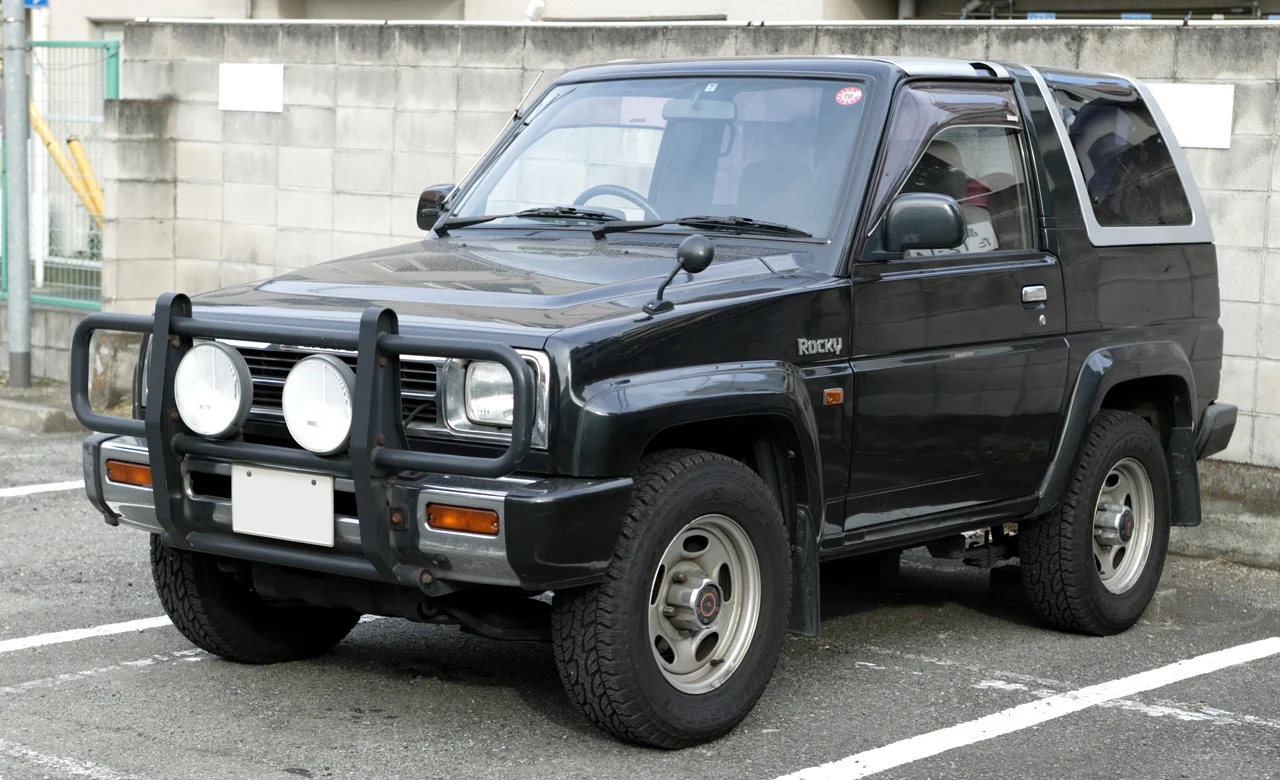
Brief Introduction of Daihatsu Rocky
The Daihatsu Rocky is a nameplate that has seen a significant evolution over the years, representing Daihatsu’s prowess in the compact SUV segment. This vehicle has a history that spans multiple generations and has been marketed under various names globally, including the Feroza and Sportrak. The Rocky has transitioned from a rugged, ladder-frame off-roader to a modern, stylish compact crossover SUV, showcasing its adaptability to changing market demands. Its popularity stems from its compact dimensions, fuel efficiency, and in its latest iteration, advanced safety features. The Rocky has seen three distinct generations, each with its own unique characteristics and variants, making it a noteworthy and enduring name in the automotive world.

Daihatsu Rocky Overview
| Brand | Daihatsu |
| Model | Rocky |
| Launch Year | 1984 (original nameplate usage) |
| Price | Varies by region and variant |
| Variants | L, X, G, Premium, Premium G, M, R, ADS, ASA (latest generation) |
| Body Type | SUV |
| Engine | 1.0L Turbocharged 3-cylinder, 1.2L Naturally Aspirated 3-cylinder, 1.2L e-Smart Hybrid |
| Power & Torque | 97 hp & 140 Nm (1.0L Turbo), 87 hp & 113 Nm (1.2L NA) |
| Transmission | CVT, 5-speed manual |
| Fuel Type | Petrol, Hybrid |
| Mileage | Approximately 18.6 km/L to 23.4 km/L (latest generation) |
| Colors | Black Mica Metallic, Compagno Red, Shining White Pearl, and others |
| Safety Rating | 5-star JNCAP (2019 model) |
| Dimensions | Length: 3995-4030 mm, Width: 1695-1710 mm, Height: 1620-1635 mm (latest generation) |
| Boot Space | 369 liters (latest generation) |
Generations and History of Daihatsu Rocky
First Generation (F70/F80 Series – 1984-2002)
The first vehicle to carry the Rocky nameplate in export markets was a rebadged Daihatsu Rugger. Launched in 1984, this model was a traditional body-on-frame SUV, designed for serious off-road use. It was available in both short and long wheelbase versions, with options for a soft top or a fixed metal top. In the UK, it was known as the Daihatsu Fourtrak. Engine options included a 2.0-liter Toyota petrol engine and a 2.8-liter diesel, with and without a turbocharger. It featured rugged solid axles with leaf springs, true to its off-road focus. A facelift in 1993 introduced independent front suspension and coil springs at the rear for improved on-road comfort.
Second Generation (F300 Series – 1989-2002)
The F300 series, launched in 1989, was a smaller mini SUV and the first to be sold as the Rocky in Japan. In many export markets, it was known as the Daihatsu Feroza to distinguish it from the larger Rugger-based Rocky. This generation maintained a body-on-frame construction and was powered by a 1.6-liter 16-valve four-cylinder petrol engine. It offered both rear-wheel-drive and part-time four-wheel-drive options with a low-range transfer case. The F300 was praised for its stylish design for the era and its genuine off-road capabilities in a compact package. Daihatsu briefly sold this model in the United States from 1990 to 1992. An interesting variation was the Bertone Freeclimber II, which used the Rocky’s chassis but was powered by a BMW engine.
Latest Generation (A200 Series – 2019-Present)
After a long hiatus, the Rocky nameplate was revived in 2019 for an all-new subcompact crossover SUV. This latest generation marked a significant departure from its predecessors, built on the modern Daihatsu New Global Architecture (DNGA) platform with a unibody construction. It is a sister model to the Toyota Raize and is also produced as the Perodua Ativa in Malaysia. The A200 Rocky is designed primarily for on-road comfort and efficiency. Powertrain options include a 1.0-liter turbocharged three-cylinder engine, a 1.2-liter naturally aspirated three-cylinder, and an innovative 1.2-liter e-Smart Hybrid series hybrid system. This generation is equipped with modern technologies such as a CVT transmission, a digital instrument cluster, a large touchscreen infotainment system, and Daihatsu’s “Smart Assist” suite of advanced safety features.
Daihatsu Rocky Facelifts and Yearly Updates
| Year | Change / Update |
| 1992 | The F300 series received an update with the introduction of the F310 variant, which featured a wider track and flared wheel arches for a more stable stance. |
| 1993 | The F70/F80 series underwent a significant update, replacing the front leaf springs with an independent suspension system and the rear leaf springs with coil springs for better ride quality. The carbureted engine was also dropped in some markets in favor of fuel injection. |
| 2021 | The A200 series lineup was updated in Japan. A 1.2-liter naturally aspirated engine was introduced for front-wheel-drive models, and the e-Smart Hybrid variant was launched. |
| 2025 | A minor facelift for the Indonesian market A200 Rocky was released, featuring a new mesh grille and a full black interior. |
Daihatsu Rocky Variants and Features
Across its generations, the Daihatsu Rocky has been offered in a variety of trims. The latest A200 series in Japan is available in L, X, G, and Premium G grades. In Indonesia, the variants are M, X, and R, with optional ADS (Astra Daihatsu Styling) and ASA (Advanced Safety Assist) packages. The interior of the modern Rocky is designed to be spacious and user-friendly, with a driver-oriented dashboard and comfortable seating for five. Higher trims feature a 9-inch touchscreen infotainment system with smartphone connectivity, a 7-inch digital instrument cluster with multiple display themes, and automatic climate control. Safety is a key focus, with the availability of Daihatsu’s Advanced Safety Assist (A.S.A) which includes features like Pre-Collision Warning, Lane Departure Warning, and Pedal Misoperation Control. It also comes with up to six SRS airbags, Vehicle Stability Control (VSC), and Hill Start Assist (HSA).
Daihatsu Rocky Engine, Performance, and Driving Experience
The first-generation Rocky (F70/F80) was known for its robust diesel and petrol engines mated to a manual transmission, delivering solid off-road performance thanks to its ladder-frame chassis and low-range gearing. The second-generation (F300) continued this off-road-oriented theme with its 1.6-liter engine, which was considered peppy for its size. The latest A200 generation offers a completely different driving experience. The 1.0-liter turbocharged engine provides brisk acceleration suitable for city driving, with 97 horsepower and 140 Nm of torque. The 1.2-liter naturally aspirated engine is a more budget-friendly option. The standout is the e-Smart Hybrid system, where a 1.2-liter engine acts as a generator to power an electric motor that drives the wheels. This results in a smooth, responsive, and quiet ride, similar to an electric vehicle, with excellent fuel efficiency. The DNGA platform provides a stable and comfortable ride with predictable handling, making it a pleasant vehicle for daily commutes and long journeys.
Daihatsu Rocky Pricing and Mileage
Pricing for the Daihatsu Rocky varies significantly based on generation, condition, and market. Early models like the F70 and F300 are now only available on the used market, with prices depending on their state of preservation and mileage. The latest A200 series is positioned as an affordable compact SUV. In markets like Indonesia and Japan, it is competitively priced against its rivals. Fuel efficiency is a strong point for the modern Rocky. The 1.0-liter turbo variant delivers a fuel economy of around 18.6 km/L, while the 1.2-liter naturally aspirated model is also very economical. The e-Smart Hybrid variant is the most frugal, with a claimed fuel consumption of up to 28 km/L in some tests. This makes the running costs of the new Rocky relatively low. Maintenance costs are generally considered reasonable, in line with other Daihatsu products known for their reliability and affordability.
Daihatsu Rocky Colors, Design, and Dimensions
The first and second-generation Rocky models had a classic, boxy SUV design that emphasized their ruggedness. They were available in a range of solid and metallic colors, often with two-tone options featuring grey lower body cladding. The latest A200 series boasts a modern and sporty design with sharp lines, a bold front grille, and LED lighting. It is available in a variety of vibrant colors, including single-tone and two-tone options with a contrasting black roof. Some of the popular colors include Compagno Red, Shining White Pearl, and Black Mica Metallic. Dimensions for the latest generation are compact, with a length of around 4 meters, making it easy to maneuver in urban environments. It has a ground clearance of 200 mm, giving it a confident stance and the ability to handle rough roads. Wheel sizes are typically 16 or 17 inches depending on the variant.
Daihatsu Rocky Safety Features
- Airbags: The latest generation is available with up to six SRS airbags, including dual front, side, and curtain airbags.
- ABS / EBD: All modern variants are equipped with an Anti-lock Braking System (ABS) and Electronic Brake-force Distribution (EBD).
- Electronic Stability Control: Vehicle Stability Control (VSC) is available to prevent skidding and maintain control during sharp turns.
- Crash Test Ratings: The Daihatsu Rocky (A200) achieved a five-star safety rating in the 2019 JNCAP (Japan New Car Assessment Program) crash tests, scoring highly in passenger and pedestrian protection.
- Other advanced safety systems: Higher trims offer the Advanced Safety Assist (A.S.A) package, which includes Pre-Collision System, Lane Departure Warning and Prevention, Adaptive Cruise Control, and Front Departure Alert.
Daihatsu Rocky Infotainment and Connectivity
Early generations of the Rocky had basic audio systems typical of their time. The current A200 series, however, is equipped with a modern infotainment system. Higher-end variants feature a large 9-inch floating touchscreen display. This system offers a range of connectivity options, including Bluetooth, USB, and smartphone integration with Apple CarPlay and Android Auto. The system is paired with a sound system that can include up to six speakers. The driver also benefits from a 7-inch TFT digital instrument cluster that is customizable with different display styles and provides important vehicle information. Some variants also offer navigation features.

Daihatsu Rocky Owner Reviews & Ratings
Owner reviews for the classic F70 and F300 Rocky models often praise their durability, simple mechanicals, and excellent off-road capabilities. They are seen as reliable and easy to maintain, though comfort and fuel economy are not their strong suits by modern standards. For the latest A200 generation, owners frequently commend its stylish design, fuel efficiency, and the practicality of its compact size combined with a spacious interior. The smooth and quiet performance of the e-Smart Hybrid variant receives particular praise. Common complaints are often related to the firm ride quality on rougher surfaces and the engine noise of the three-cylinder engines under hard acceleration. Overall, the new Rocky is generally well-regarded for its value for money and comprehensive feature list in the compact SUV segment.
Daihatsu Rocky Comparison with Similar Cars
The latest Daihatsu Rocky (A200) competes in a crowded compact SUV market. Its closest competitor is its sibling, the Toyota Raize, with which it shares its platform and powertrains. The choice between the two often comes down to brand preference and minor styling differences. Another key competitor is the Suzuki Jimny, which, unlike the Rocky, is a dedicated off-roader with a ladder-frame chassis. While the Jimny is far more capable off-road, the Rocky offers significantly better on-road comfort, interior space, and fuel economy. Other rivals include the Kia Stonic and Hyundai Venue, which offer similar dimensions and features. The Rocky often stands out for its available hybrid powertrain and its strong safety ratings from JNCAP.
Daihatsu Rocky Awards and Recognition
- Best Newcomer Award: The Daihatsu Rocky (A200) received the “Best Newcomer Award” at the Carvaganza Editors’ Choice Awards in 2021, shortly after its launch in the Indonesian market.
Interesting Facts about Daihatsu Rocky
- The second-generation Rocky (F300) was re-engineered by the Italian coachbuilder Bertone and sold as the Bertone Freeclimber II, featuring a BMW engine.
- Daihatsu had a short-lived presence in the US market from 1988 to 1992, where the Rocky and the Charade were its main offerings.
- The “Feroza” name, used for the F300 Rocky in many markets, is a portmanteau of “ferocious” and the name “Rosa.”
- In Japan, the F300 Rocky was also known by the intriguing name “Lovibond Rocky”.
Daihatsu Rocky Legacy and Influence
The Daihatsu Rocky has carved out a significant legacy in the compact SUV segment. The early generations (F70 and F300) were instrumental in popularizing small, affordable, and capable 4x4s, offering a fun and accessible entry into off-roading for many. They built a reputation for toughness and reliability that still resonates with enthusiasts. The revival of the Rocky nameplate with the A200 series demonstrates Daihatsu’s ability to adapt to modern automotive trends. By shifting to a crossover platform, Daihatsu has ensured the Rocky’s continued relevance in a market that now prioritizes fuel efficiency, safety, and technology over outright off-road prowess. The success of the A200 Rocky and its rebadged siblings has solidified Daihatsu’s position as a leader in the small vehicle segment in Japan and Southeast Asia.
Daihatsu Rocky Global Availability
The availability of the Daihatsu Rocky has varied greatly by generation and region. The F70 series was widely exported and sold as the Rocky, Fourtrak, or Rugger in Europe, Australia, and parts of Asia. The F300 was also sold globally under various names, including a brief stint in the United States. The latest A200 generation is primarily focused on the Japanese and Southeast Asian markets. It is manufactured in Japan for the domestic market. For the Indonesian market, it is produced locally at the Karawang plant. It is also manufactured in Malaysia as the Perodua Ativa. While the Rocky itself is not sold in Europe or North America, its platform is utilized in various global models, showcasing its importance to Daihatsu and Toyota’s small car strategy.
Daihatsu Rocky Maintenance and Ownership Costs
Ownership costs for the Daihatsu Rocky are generally considered to be low. For the older F70 and F300 models, their simple mechanicals make them relatively easy and inexpensive to maintain for those with mechanical knowledge, though the availability of specific parts may be a concern in some regions. The new A200 series benefits from modern engineering and is designed for low maintenance. Daihatsu recommends regular servicing, with oil changes and inspections at set intervals. Spare parts are readily available in the markets where it is officially sold, such as Japan and Indonesia. The fuel-efficient engines and hybrid option contribute to low running costs. The resale value of the latest generation is expected to be competitive, thanks to its popularity and Daihatsu’s reputation for reliability.
Final Words about Daihatsu Rocky
The Daihatsu Rocky is a vehicle with a rich and varied history, successfully transitioning from a rugged off-roader to a sophisticated and efficient compact crossover. Its enduring appeal lies in its ability to offer practicality, affordability, and a fun driving experience in a compact package. The classic models remain cherished by off-road enthusiasts for their simplicity and toughness. The latest generation is an excellent choice for city dwellers and small families looking for a stylish, safe, and economical SUV. With its modern technology, advanced safety features, and the option of an innovative hybrid system, the Daihatsu Rocky is well-positioned to continue its legacy of success in the ever-evolving automotive landscape.