
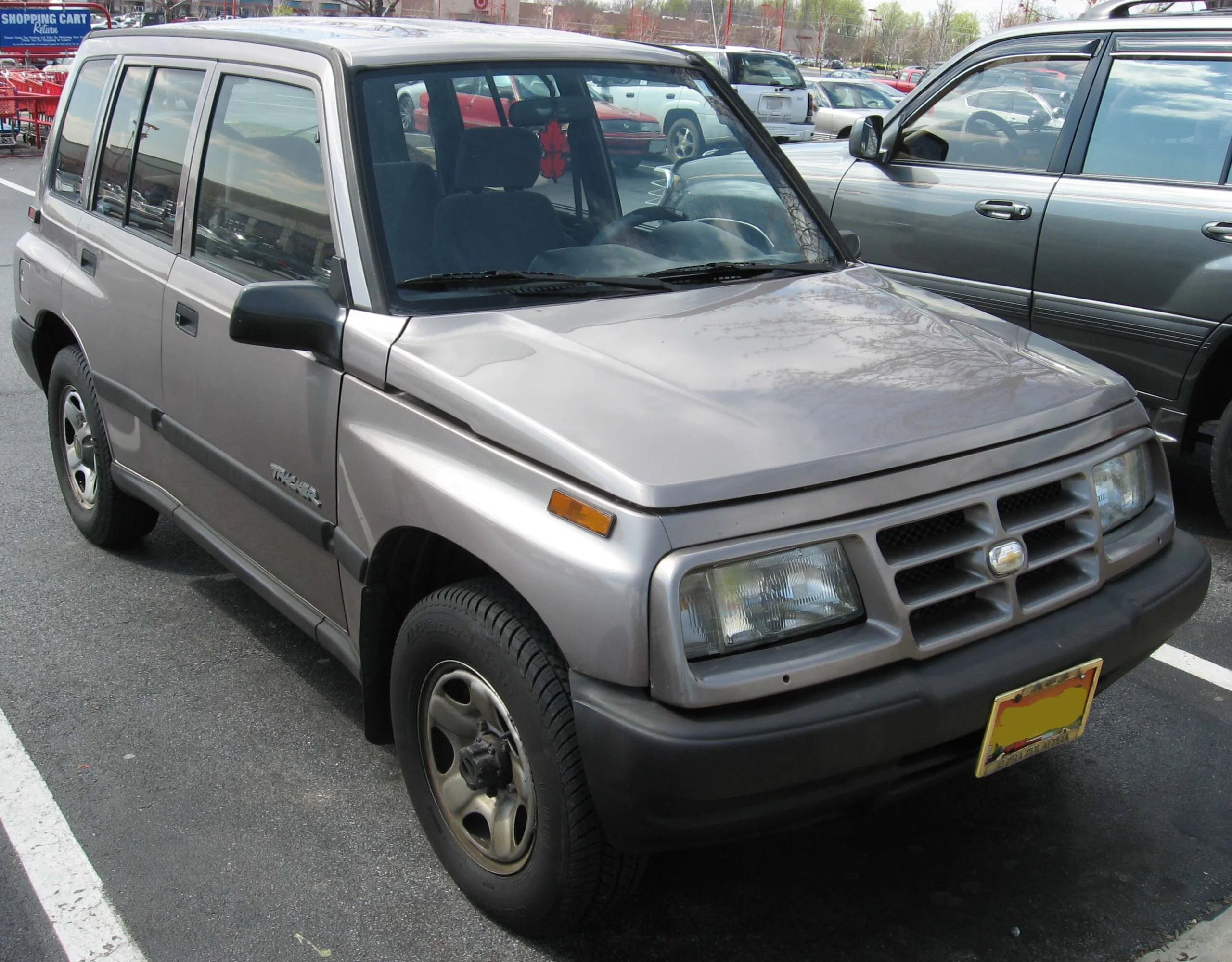
Brief Introduction of Geo Tracker
The Geo Tracker is a mini SUV that carved a unique niche in the automotive market with its compact size, rugged capabilities, and fun-loving persona. A product of the CAMI (Canadian Automotive Manufacturing Inc.) joint venture between General Motors and Suzuki, the Tracker was essentially a rebadged version of the Suzuki Sidekick (also known as the Escudo in Japan). It appealed to a wide range of buyers, from those seeking an affordable and fuel-efficient daily driver to off-road enthusiasts who appreciated its lightweight construction and true 4×4 capabilities. Over its production run under the Geo brand, the Tracker was available in multiple configurations, including two-door convertible and hardtop models, and later a four-door hardtop, offering versatility across its different generations and variants.

Geo Tracker Overview
| Brand | Geo |
| Model | Tracker |
| Launch Year | 1989 |
| Price | Original MSRP varied by year and trim; currently available on the used market. |
| Variants | 2-door Convertible, 2-door Hardtop, 4-door Hardtop, Base, LSi |
| Body Type | SUV |
| Engine | 1.6L 8-valve SOHC I4, 1.6L 16-valve SOHC I4 |
| Power & Torque | 80 hp & 93 lb-ft (8-valve), 95-96 hp & 98-103 lb-ft (16-valve) |
| Transmission | 5-speed manual, 3-speed automatic, 4-speed automatic |
| Fuel Type | Gasoline |
| Mileage | Approximately 19-24 MPG city / 22-26 MPG highway |
| Colors | Included various metallics and solids like Scuba Blue, Woodland Green, Wildfire Red, and Silver Sage. |
| Safety Rating | Not rated by modern standards; featured dual airbags from 1996 onwards. |
| Dimensions | Varies by body style. 4-door length: ~158.7 in, 2-door length: ~143.7 in. |
| Boot Space | Up to 45 cubic feet with rear seats folded in 4-door models. |
Generations and History of Geo Tracker
First Generation (1989–1998)
The first-generation Geo Tracker was introduced in late 1988 for the 1989 model year as a mini SUV. It was developed as part of a joint venture between General Motors and Suzuki, known as CAMI. The Tracker was mechanically identical to the Suzuki Sidekick. Initially, it was launched as a two-door model, available as either a convertible or a hardtop. The standard engine was a 1.6-liter 8-valve four-cylinder engine producing 80 horsepower. It was built on a rugged body-on-frame chassis, which gave it credible off-road capabilities, especially when equipped with its part-time four-wheel-drive system that included a low-range transfer case. Early models were primarily 4WD, with a two-wheel-drive convertible version being introduced later. Trim levels included a base model and the more upscale LSi, which offered features like air conditioning and custom wheels.
Second Generation (As Chevrolet Tracker)
After the Geo brand was discontinued in 1997, the Tracker was rebadged as a Chevrolet for the 1998 model year, continuing the first-generation body style for one year. An all-new, second-generation Tracker was introduced in 1999 under the Chevrolet brand. This new model featured a more rounded and modern design, moving away from the boxy look of its predecessor. It was available as a two-door convertible and a four-door hardtop. The second generation offered more powerful engine options, including a 2.0-liter 4-cylinder and a 2.5-liter V6 engine for the four-door models. While it was still based on its Suzuki counterpart (now the Vitara and Grand Vitara), the second-generation Tracker aimed for a more refined on-road experience with an updated chassis and the introduction of rack-and-pinion steering, a departure from the first generation’s more rugged recirculating ball system.
Latest Generation
The Geo Tracker as a brand and model is discontinued. The Chevrolet Tracker nameplate was retired in the North American market after the 2004 model year and was eventually replaced by the Chevrolet Equinox. However, the “Tracker” name has been revived by Chevrolet in other global markets, such as South America and China, for a completely different line of subcompact crossover SUVs that do not share the lineage or body-on-frame construction of the original Geo Tracker.
Geo Tracker Facelifts and Yearly Updates
| Year | Change / Update |
| 1991 | A 2-wheel-drive convertible model was introduced, available only with a 5-speed manual transmission. Base models received black bumpers and door handles, and LSi models gained automatic-locking hubs. |
| 1992 | Tilt steering wheel became an available option. |
| 1994 | A more powerful 95-horsepower, 1.6L 16-valve engine was introduced for models sold in California and New York. |
| 1995 | The 95-horsepower 16-valve engine became standard on all 4WD models. The two-door hardtop body style was discontinued. |
| 1996 | A four-door hardtop model was introduced for the first time, featuring a longer wheelbase. All models received dual airbags and a revised front-end design. Optional 4-wheel anti-lock brakes were made available. |
| 1997 | The upscale LSi two-door convertible trim was dropped. The base convertible gained a standard folding rear bench seat. |
| 1998 | The Geo brand was discontinued, and the Tracker was rebadged as a Chevrolet for its final year of the first-generation design. |
Geo Tracker Variants and Features
Throughout its production, the Geo Tracker was offered in several variants to cater to different customer needs. The primary distinction was between the two-door and four-door models. The two-door was available as a soft-top convertible, offering an open-air driving experience, or a hardtop, providing a more enclosed cabin. The four-door model, introduced in 1996, provided more interior space and practicality for families. Trim levels consisted of the base model and the more premium LSi. The LSi package typically included features such as air conditioning, intermittent wipers, a rear window wiper/washer, tinted glass, and upgraded upholstery and wheels. The interior was functional and straightforward, with manually operated windows and locks on most models. Later years saw the introduction of more car-like dashboards and improved ergonomics, particularly with the 1996 redesign which also brought dual airbags. Safety features for the era were basic, with rear-wheel anti-lock brakes being an early feature and optional four-wheel ABS available later on.
Geo Tracker Engine, Performance, and Driving Experience
The driving experience of the Geo Tracker was defined by its light weight and compact dimensions. Early models were equipped with a 1.6-liter, 8-valve, 4-cylinder Suzuki engine that produced 80 horsepower and 93 lb-ft of torque. While not powerful, this engine was adequate for the vehicle’s light weight. In 1994, a 16-valve version of the 1.6-liter engine was introduced, boosting output to a more capable 95 horsepower and 98 lb-ft of torque. Transmission choices included a standard 5-speed manual, which was praised for being engaging, a 3-speed automatic on two-door models, and a 4-speed automatic on the later four-door models. The Tracker’s body-on-frame construction and short wheelbase made it a nimble and capable off-roader, but this resulted in a somewhat bouncy ride on paved roads. Its handling was truck-like due to the recirculating ball steering system, which was excellent for rugged terrain but less precise for highway driving. Acceleration was modest, with 0-60 mph times well over 10 seconds, making highway merging a planned event.
Geo Tracker Pricing and Mileage
One of the key selling points of the Geo Tracker was its affordability. When new, it was one of the least expensive SUVs on the market, appealing to budget-conscious buyers and those looking for a capable second vehicle. For example, a top-of-the-line 1996 LSi four-door 4WD model had a starting price of around $15,710. Due to its age, the Geo Tracker is now only available on the used car market, where prices can vary significantly based on condition, mileage, and modifications. Fuel efficiency was another strong suit. The lightweight construction and small-displacement engines resulted in impressive mileage for an SUV of its time. Owners could expect to achieve around 19-24 miles per gallon in the city and 22-26 miles per gallon on the highway, depending on the engine and transmission combination. Its simple mechanicals generally lead to reasonable maintenance and running costs.
Geo Tracker Colors, Design, and Dimensions
The Geo Tracker’s design was a classic mini-SUV look, characterized by its boxy proportions, short overhangs, and a tall, narrow stance. This utilitarian design not only gave it a distinct appearance but also contributed to its excellent off-road maneuverability. It featured large windows for good visibility and a side-hinged rear door with an externally mounted spare tire. A range of vibrant colors was available over the years, including Scuba Blue Metallic, Woodland Green Metallic, Wildfire Red, Silver Sage Metallic, and Black. Dimensions varied between the body styles. The two-door models had a wheelbase of 86.6 inches and an overall length of about 143.7 inches. The four-door model, introduced in 1996, was larger, with a wheelbase of 97.6 inches and an overall length of 158.7 inches, providing more interior and cargo space. It sat on 15-inch wheels and had a respectable ground clearance of around 7.9 inches.
Geo Tracker Safety Features
For its era, the Geo Tracker came with a basic set of safety features. Early models were quite spartan. Key safety updates were made over its lifecycle:
- Airbags: Dual front airbags were made standard for all models starting in 1996.
- ABS / EBD: Rear-wheel anti-lock brakes were standard on some models. An optional four-wheel anti-lock braking system (ABS) that worked in both 2WD and 4WD modes became available in 1996.
- Electronic Stability Control: This technology was not available on the Geo Tracker.
- Crash Test Ratings: The Geo Tracker was not subjected to the same rigorous crash testing standards that are in place today, and historical ratings are not directly comparable to modern vehicle ratings.
- Other advanced safety systems: The Tracker featured a body-on-frame construction which provided a degree of ruggedness. Daytime running lights were added in 1996 to improve visibility.
Geo Tracker Infotainment and Connectivity
The infotainment and connectivity options in the Geo Tracker were reflective of the technology available in the late 1980s and 1990s. The systems were simple and functional, focusing on the basics of in-car entertainment. A standard factory-installed system would typically include an AM/FM stereo radio, and a cassette tape player was a common feature or option. Upgraded sound systems were available on higher trim levels like the LSi. Advanced features common today, such as touchscreens, Apple CarPlay, Android Auto, navigation systems, Bluetooth connectivity, and USB ports, were not available during the Geo Tracker’s production run. Any such features found in a Geo Tracker today would be the result of aftermarket modifications.

Geo Tracker Owner Reviews & Ratings
The Geo Tracker has maintained a loyal following over the years, and owner reviews are generally positive, especially from those who appreciate its specific strengths. Common praises often highlight its excellent reliability and durability, with many Trackers remaining on the road with high mileage. Its impressive fuel economy is another frequently cited benefit. Owners consistently laud its off-road capability, comparing it favorably to much larger and more expensive SUVs. On the downside, common complaints include a lack of power, particularly with the 80-horsepower engine, a bouncy and noisy ride on the highway, and a spartan interior with limited creature comforts. Despite these drawbacks, the overall sentiment is that the Tracker is a fun, affordable, and dependable vehicle, particularly valued for its simplicity and ease of maintenance.
Geo Tracker Comparison with Similar Cars
During its time, the Geo Tracker competed in the emerging mini-SUV segment. Its primary competitors included:
- Suzuki Sidekick: Its mechanical twin, the Sidekick was nearly identical in every aspect, with minor differences in branding and available options.
- Suzuki Samurai: A smaller and more hardcore off-roader, the Samurai was less comfortable and practical for daily driving compared to the Tracker.
- Jeep Wrangler (YJ): The Wrangler was a more established and robust off-road vehicle with a larger engine and a higher price point. It offered superior rock-crawling capability but a harsher on-road ride.
- Toyota RAV4 (First Generation): Introduced in the mid-1990s, the RAV4 was a significant competitor. Based on a car platform, it offered a much more comfortable and refined on-road driving experience but was less capable in serious off-road conditions than the body-on-frame Tracker.
- Kia Sportage (First Generation): Similar to the Tracker, the early Sportage was a body-on-frame SUV that offered a blend of on-road usability and off-road potential at a competitive price.
The Geo Tracker’s main advantages were its low price, excellent fuel economy, and its balance of being a competent daily driver that was also a genuinely capable off-road vehicle.
Geo Tracker Awards and Recognition
- Information not disclosed
Interesting Facts about Geo Tracker
- The Geo brand itself was a short-lived GM division created to market small, imported, or jointly-developed vehicles.
- Due to production delays at the CAMI plant in Canada, nearly all 1989 and many 1990 model year Trackers were actually built in Japan by Suzuki.
- In addition to being sold as the Geo Tracker and Suzuki Sidekick in North America, this vehicle was known by many other names around the world, including the Suzuki Vitara, Santana 300/350 in Spain, and Pontiac Sunrunner in Canada.
- The Tracker’s body-on-frame construction made it a popular choice for being towed behind recreational vehicles (RVs).
Geo Tracker Legacy and Influence
The Geo Tracker played a significant role in popularizing the mini-SUV segment in North America. It offered a unique combination of utility, affordability, and off-road prowess that was largely unmatched by domestic automakers at the time. Its “fun-in-the-sun” image, especially the convertible model, created a strong cultural identity and attracted a youthful demographic. The Tracker, along with its Suzuki sibling, demonstrated the viability of small, efficient SUVs, paving the way for the wave of car-based compact crossovers that would come to dominate the market in subsequent years, such as the Toyota RAV4 and Honda CR-V. Though the Geo brand and the original Tracker are gone, they are remembered fondly by enthusiasts for their durability, simplicity, and adventurous spirit, maintaining a strong cult following to this day.
Geo Tracker Global Availability
While the Geo Tracker was specifically a North American market vehicle sold through Chevrolet dealerships, its underlying platform, the Suzuki Escudo/Vitara, was a global success. The vehicle was manufactured in several countries, including Japan, Canada (at the CAMI plant), and Spain. It was sold in various forms and under numerous nameplates across the globe. For instance, in Canada, besides the Geo Tracker, it was also sold as the Asüna Sunrunner and later the Pontiac Sunrunner. In Latin American markets, it was often badged as the Chevrolet Vitara. This global platform was available in both left-hand and right-hand drive configurations, tailored to the specific needs and regulations of each market.
Geo Tracker Maintenance and Ownership Costs
Ownership of a Geo Tracker is generally associated with low costs. Its simple and robust engineering means that many repairs and maintenance tasks can be performed by a competent home mechanic. Service intervals are typical for vehicles of its era. The availability of spare parts is excellent, thanks to its shared platform with the widely sold Suzuki Sidekick/Vitara, with a strong aftermarket community providing both standard and performance-oriented components. Its resale value has remained surprisingly strong, particularly for well-maintained 4×4 models, due to high demand from off-road enthusiasts and those seeking a simple, reliable utility vehicle. Warranty on these vehicles has long since expired due to their age.
Final Words about Geo Tracker
The Geo Tracker stands as a memorable icon from a distinct era in the automotive industry. It successfully blended the ruggedness of a traditional SUV with the compact dimensions and fuel efficiency of a small car. For buyers today, a well-preserved Geo Tracker offers a unique and engaging driving experience, a world away from modern, tech-laden SUVs. It is an ideal vehicle for those who value mechanical simplicity, off-road capability, and a touch of nostalgic charm. While it may lack modern comforts and safety features, its reliability, low running costs, and unwavering can-do attitude ensure its enduring appeal. The future of the Geo Tracker lies in the hands of a dedicated enthusiast community that continues to celebrate and preserve this capable and charismatic mini-SUV.