
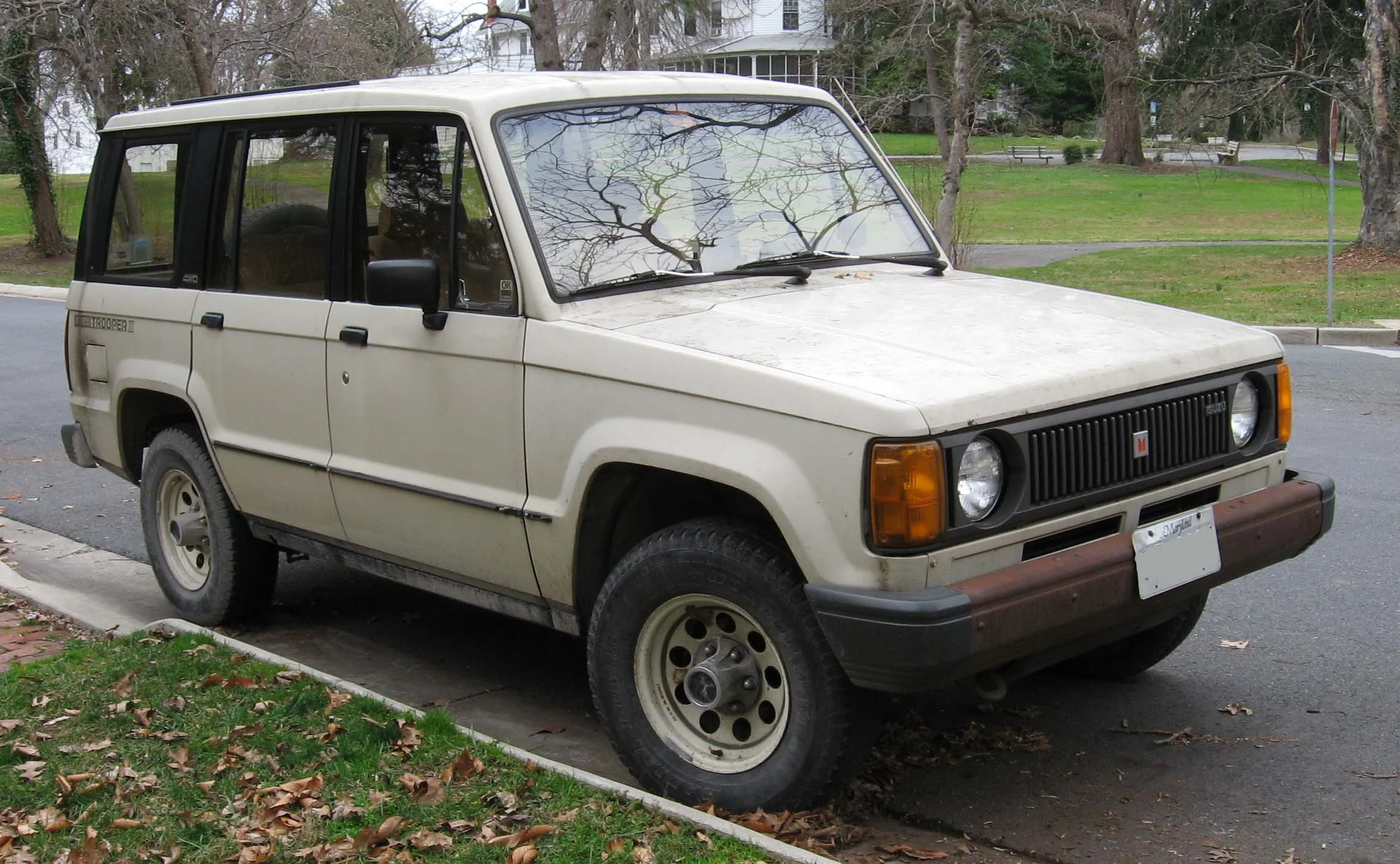
## Brief Introduction of Isuzu Trooper
The Isuzu Trooper is a full-size sport utility vehicle (SUV) that carved out a niche for itself as a rugged and capable off-road vehicle. Produced over two distinct generations, the Trooper became known for its durable body-on-frame construction, spacious interior, and straightforward, utilitarian design. Initially launched as a fairly basic 4×4, it evolved to offer more comfort, convenience, and power, competing with other established players in the growing SUV market. Its reputation for toughness and reliability, particularly in its earlier years, made it a popular choice for adventurers and families who required a vehicle that could handle demanding conditions. The Trooper was marketed globally under various names, including the Isuzu Bighorn in Japan, the Holden Jackaroo in Australia, and the Opel Monterey in Europe, showcasing its worldwide reach and adaptability to different markets. Although discontinued, the Isuzu Trooper specs and its legacy as a formidable off-roader continue to attract a dedicated following of enthusiasts.
Isuzu Trooper Overview
| Brand | Isuzu |
| Model | Trooper |
| Launch Year | 1981 |
| Price | Original MSRP ranged from ~$10,000 in the 1980s to over $37,000 by 2002 |
| Variants | S, LS, Limited, RS (short-wheelbase), Duty, Citation |
| Body Type | SUV (3-door and 5-door) |
| Engine | Gasoline: 1.9L I4, 2.3L I4, 2.6L I4, 2.8L V6, 3.2L V6 (SOHC & DOHC), 3.5L V6. Diesel: 2.2L I4, 2.3L I4, 2.8L I4, 3.0L I4, 3.1L I4 |
| Power & Torque | Ranged from ~73 hp to 215 hp and ~95 lb-ft to 230 lb-ft of torque |
| Transmission | 4-speed manual, 5-speed manual, 4-speed automatic |
| Fuel Type | Gasoline, Diesel |
| Mileage | Combined MPG generally ranged from the mid-teens to low-20s depending on engine and year |
| Colors | Included various single and two-tone options like Ebony Black, Pure White, Satin Gold, and Moonmist Gray Mica |
| Safety Rating | IIHS Moderate Overlap Front (2000-02 models): Marginal. NHTSA ratings were reportedly low, but specific data is not consistently available. |
| Dimensions | Length: 4,075-4,750 mm (160.4-187.0 in), Width: 1,650-1,835 mm (65.0-72.2 in), Height: 1,800-1,845 mm (70.9-72.6 in) |
| Boot Space | Up to 117.8 cu ft (3,340 L) with rear seats folded in 5-door models |
Generations and History of Isuzu Trooper
First Generation (1981-1991)
The first-generation Isuzu Trooper was introduced in 1981, initially in Japan as the Isuzu Rodeo Bighorn. It entered the global market as a no-frills, highly capable off-road vehicle built on a rugged body-on-frame platform derived from Isuzu’s pickup trucks. Early models were spartan, offering a choice of a three-door wagon or a short-lived soft-top version. Power came from modest four-cylinder gasoline and diesel engines paired with manual transmissions and a part-time four-wheel-drive system. The interior was basic and focused on durability over luxury. Over its ten-year production run, the first-generation Trooper saw significant evolution. A five-door, long-wheelbase version was introduced, greatly increasing its practicality and appeal to families. Engine options were progressively upgraded, with the introduction of larger and more powerful four-cylinder engines and eventually a GM-sourced 2.8-liter V6, which provided a much-needed performance boost. By the end of its run, amenities such as air conditioning and power windows became available, signaling a shift toward greater comfort and convenience.

Second Generation (1991-2002)
Launched in late 1991 for the 1992 model year, the second-generation Trooper was a complete redesign that aimed to make the SUV larger, more powerful, and more luxurious to compete in the rapidly growing SUV market. It featured a more rounded and modern design, a significantly more refined interior, and improved on-road manners. Initially available as a five-door model, a sportier three-door “RS” version on a shorter wheelbase was offered from 1993 to 1995. The standard engine was a 3.2-liter V6, available in both Single Overhead Cam (SOHC) and a more powerful Dual Overhead Cam (DOHC) configuration for higher trim levels. The second generation also saw continuous updates, including the addition of dual airbags, the adoption of a shift-on-the-fly 4WD system, and a major facelift in 1998 which brought new styling and a more powerful 3.5-liter V6 engine that produced 215 horsepower. This generation was also the basis for numerous rebadged models, including the Acura SLX in the United States. Despite its improvements, this generation’s reputation was impacted by a controversy over its alleged rollover risk, which, combined with declining sales, led to its discontinuation in North America in 2002.
Latest Generation
The Isuzu Trooper was discontinued and does not have a latest generation. Production ceased in the United States after the 2002 model year and in other global markets shortly thereafter. Isuzu shifted its focus in the passenger vehicle market to other models, such as the Isuzu Ascender (a rebadged GMC Envoy) and the Isuzu Axiom, before ultimately withdrawing from the U.S. consumer market entirely to concentrate on commercial vehicles. There are no currently available versions of the Isuzu Trooper being manufactured.
Isuzu Trooper Facelifts and Yearly Updates
| Year | Change / Update |
| 1983 | A five-door, long-wheelbase version of the first generation was introduced. |
| 1986 | An upgraded 2.3-liter four-cylinder engine became available. Four-door models were introduced to the U.S. market. |
| 1987 | Rectangular headlights were introduced. The suspension was updated for a wider track. |
| 1988 | A more powerful 2.6-liter fuel-injected four-cylinder engine was offered. |
| 1989 | A 2.8-liter V6 engine from General Motors was added to the lineup. |
| 1992 | The second generation was launched with a complete redesign and a new 3.2L V6 engine (SOHC and DOHC options). |
| 1993 | A short-wheelbase, two-door RS model was introduced. |
| 1995 | Dual front airbags were added. The two-door RS model was discontinued. |
| 1996 | A “shift-on-the-fly” engagement system for the 4WD was introduced on some models. The DOHC engine was replaced by a more powerful 190 hp SOHC 3.2L V6 across the lineup. |
| 1998 | Major facelift with a new grille, headlamps, and bumpers. A new, more powerful 3.5L DOHC V6 engine (215 hp) was introduced. A “Torque-On-Demand” (TOD) all-wheel-drive system became available. |
| 2000 | The front grille was redesigned again. |
| 2002 | Final model year in the U.S. Minor updates included making the power moonroof standard on LS trims and privacy glass on S models. |
Isuzu Trooper Variants and Features
Across its two generations, the Isuzu Trooper was offered in several variants, or trim levels, that ranged from basic and utilitarian to near-luxury. The primary trims in the U.S. market were the base ‘S’, the mid-range ‘LS’, and the top-tier ‘Limited’.
The base ‘S’ model typically came with the essentials. In the second generation, this included the V6 engine, but with fewer convenience features. Interior upholstery was usually cloth, and features like power windows and locks were not always standard in the early years. By the end of its run, even the S model included amenities like manual air conditioning and a radio with a cassette player.
The ‘LS’ trim was the volume seller and added more comfort and convenience features. This often included upgraded cloth interiors, power windows, power door locks, cruise control, and a better sound system. In the second generation, the LS often featured alloy wheels and could be optioned with features like a CD changer and a large power moonroof.
The ‘Limited’ trim was the most luxurious, offering features like standard leather upholstery, heated front seats, woodgrain interior trim, and a two-tone exterior paint scheme. It often came standard with the most powerful engine available for that model year, such as the DOHC 3.2L V6 or later the 3.5L V6, and included the 4-speed automatic transmission and advanced 4WD systems as standard equipment. By the final model years, a premium Nakamichi audio system was available for the Limited trim.
A notable variant was the short-wheelbase, three-door ‘RS’ model, available from 1993 to 1995. It offered a sportier appearance and was generally equipped similarly to the higher-end LS models. In other markets, trims like ‘Duty’ and ‘Citation’ were used, often corresponding to base and premium levels, respectively.
Isuzu Trooper Engine, Performance, and Driving Experience
The Isuzu Trooper’s powertrain story is one of steady evolution from basic utility to competitive SUV performance. The first generation began with small, underpowered four-cylinder engines, such as a 1.9-liter gasoline unit and a 2.2-liter diesel, which prioritized economy and durability over speed. The driving experience was truck-like, with a firm ride due to its leaf-spring rear suspension. Performance improved significantly with the introduction of a 2.6-liter inline-four and later a 2.8-liter GM-sourced V6, which finally gave the Trooper more adequate acceleration for highway driving.
The second generation marked a major leap in performance and refinement. The launch engines were 3.2-liter V6s: a 175-hp SOHC version for base models and a 190-hp DOHC for premium trims. This provided much stronger acceleration and passing power. The suspension was also upgraded to an independent front with torsion bars and a coil-sprung multi-link solid rear axle, which greatly improved ride quality and handling on paved roads without sacrificing its renowned off-road capability. In 1998, the Trooper received its most potent engine, a 3.5-liter DOHC V6 producing 215 horsepower and 230 lb-ft of torque, making it competitive with rivals of the era. Transmission options included a durable 5-speed manual and a 4-speed automatic, which became the standard on most later models. The available Torque-On-Demand 4WD system on later models enhanced stability by automatically transferring power to the wheels with the most grip.
Isuzu Trooper Pricing and Mileage
When new, the Isuzu Trooper was positioned as a competitively priced, value-oriented alternative to rivals like the Toyota Land Cruiser. In its early years, prices were modest, reflecting its basic, utilitarian nature. As the Trooper evolved and gained features, its price increased accordingly. For its final model year in 2002, the manufacturer’s suggested retail price (MSRP) for a base Trooper S was approximately $30,015, while a fully-equipped Limited model could cost over $37,270.
Fuel efficiency was never the Trooper’s strongest attribute, a common trait for truck-based SUVs of its time. For the second-generation V6 models, combined EPA mileage ratings were typically in the range of 15-17 MPG. For example, the 2002 models with the 3.5L V6 engine were rated at 14 MPG in the city and 18 MPG on the highway. Real-world mileage reported by owners often aligns with these figures, with some achieving slightly better economy on long highway trips. Diesel models, which were more common in markets outside of North America, offered significantly better fuel economy.
Today, the Isuzu Trooper specs make it an affordable vehicle on the used market, with prices varying widely based on condition, mileage, and generation. The average sale price hovers around $9,920, though pristine examples can fetch much higher amounts, while project-worthy vehicles can be found for less. Maintenance costs are generally considered reasonable, though the availability of certain specific parts can be a challenge due to Isuzu’s departure from the US passenger vehicle market, which can sometimes lead to higher repair costs.
Isuzu Trooper Colors, Design, and Dimensions
The design of the Isuzu Trooper was a clear reflection of its purpose. The first generation (1981-1991) was characterized by a distinctly boxy, utilitarian aesthetic with sharp lines and flat body panels, emphasizing its ruggedness. It was available in both short-wheelbase three-door and long-wheelbase five-door configurations. The exterior was simple, with early models featuring round headlights that were later updated to rectangular units.
The second generation (1992-2002) introduced a more modern and aerodynamic, yet still substantial, design. The lines were softer, the body was larger, and the overall appearance was more upscale to compete with contemporary SUVs. The 1998 facelift further refined the look with a new grille and redesigned headlamps. A signature design element of the five-door models was the 70/30 split rear “barn doors,” which provided versatile access to the cargo area.
Available colors varied by model year and trim but included a range of solid and metallic paints. Common colors for later models included Ebony Black, Pure White, Satin Gold Metallic, Moonmist Gray Mica, and two-tone combinations on Limited trims. The interior design evolved from sparse and functional in the first generation to comfortable and well-equipped in the second, with later Limited models featuring leather and woodgrain trim.
Dimensionally, the Trooper was a full-size SUV. The long-wheelbase five-door second-generation model had a length of about 187.8 inches, a width of 72.2 inches, and a height of 72.2 inches, with a wheelbase of 108.7 inches. It offered generous ground clearance, typically over 8 inches, and came with wheel sizes ranging from 15 to 16 inches depending on the year and trim.
Isuzu Trooper Safety Features
- Airbags: Dual front airbags became standard starting with the 1995 model year. Side airbags were not offered.
- ABS / EBD: Rear-wheel anti-lock brakes (ABS) were standard on the second generation, with four-wheel ABS being optional on some trims and later becoming standard on all models by 1997. Electronic Brakeforce Distribution (EBD) was not a common feature during its production run.
- Electronic Stability Control: The Trooper was not equipped with electronic stability control.
- Crash Test Ratings: The Insurance Institute for Highway Safety (IIHS) tested the 2001 Trooper (applicable to 2000-02 models) and gave it an overall rating of “Marginal” for the moderate overlap frontal crash test. The IIHS noted issues with the control of the test dummy’s movement and the potential for high repair costs from low-speed impacts. Specific NHTSA star ratings are not readily available, though some reports mention the vehicle received poor ratings in frontal crash tests.
- Other advanced safety systems: For its era, the Trooper was not equipped with advanced safety systems like traction control (beyond the capabilities of the 4WD system) or blind-spot monitoring. Child door locks and child seat anchors were standard features on later models.
Isuzu Trooper Infotainment and Connectivity
The infotainment and connectivity options in the Isuzu Trooper were characteristic of the technology available during its production years. The first generation offered very basic systems, starting with a simple AM/FM radio. By the end of its run, a cassette player was a common feature, representing the standard for in-car entertainment of the 1980s.
The second generation saw a significant upgrade in audio and convenience technology. Early models continued with radio and cassette players, but as the 90s progressed, a single-disc CD player became an option. Higher trim levels like the LS and Limited often featured more advanced sound systems with multiple speakers. By the end of its production, a 6-disc in-dash CD changer became a popular feature, and was standard on the LS and Limited trims for the 2002 model year. For the final year, the top-of-the-line Limited model offered a premium Nakamichi audio system, which was a high-end feature for the time.

Modern connectivity features such as Apple CarPlay, Android Auto, touchscreen navigation, Bluetooth, USB ports, and wireless charging were not available, as the Trooper was discontinued before these technologies became mainstream in automobiles.
Isuzu Trooper Owner Reviews & Ratings
Owner reviews for the Isuzu Trooper, particularly the second generation, are generally positive, with many owners praising its reliability, off-road capability, and cavernous interior space. For the 1992-2002 generation, owners on Kelley Blue Book give it a high rating of 4.5 out of 5, with 96% recommending the vehicle. Common points of praise include its durable truck-based frame, powerful V6 engines (especially the 3.5L), and confident performance in snow and on trails. Many owners report long-term ownership with high mileage, citing the vehicle’s mechanical simplicity and robust build quality.
However, there are several common complaints. The most frequently cited issue, especially for post-1998 models, is the reliability of the 4L30-E 4-speed automatic transmission, with many owners reporting failures. The 3.5L V6 engine is also known for issues with oil consumption, requiring owners to check oil levels frequently. Fuel economy is another common criticism, with the V6 engines being quite thirsty. Owners of first-generation models appreciate their simplicity and off-road prowess but note that they are often underpowered and have a more utilitarian, less comfortable ride. The difficulty in sourcing certain replacement parts due to Isuzu’s withdrawal from the U.S. market is a recurring concern for owners of both generations.
Isuzu Trooper Comparison with Similar Cars
Throughout its production, the Isuzu Trooper competed in a crowded and capable SUV segment. Its primary rivals included the Toyota 4Runner, Mitsubishi Montero (Pajero), Ford Explorer, and Jeep Cherokee.
vs. Toyota 4Runner: This was a classic matchup of Japanese 4x4s. The Trooper generally offered more interior and cargo space, making it a more practical choice for families or those hauling a lot of gear. In later years, the Trooper’s 3.5L V6 engine also produced more horsepower than the contemporary 4Runner’s base engine. However, the 4Runner typically held an advantage in fuel efficiency and had a stronger reputation for long-term reliability and higher resale value.
vs. Mitsubishi Montero: Like the Trooper, the Montero was a globally recognized, rugged SUV with strong off-road credentials and available in both long and short-wheelbase versions. Both vehicles offered similar levels of capability and were often cross-shopped. The Montero was known for its innovative features for the time, such as an adjustable suspension on some models. The choice between the two often came down to brand preference and specific features on available trim levels.
vs. Ford Explorer: The Ford Explorer, especially from the mid-90s onward, became the sales leader in the SUV segment. The Explorer often offered a more car-like ride and a wider range of available comfort and luxury features, appealing to a broader, more suburban audience. While V8 engine options gave the Explorer a performance edge, the Trooper was generally considered to be the more robust and capable vehicle in serious off-road conditions due to its traditional body-on-frame construction and simpler, more durable 4WD systems.
vs. Jeep Cherokee (XJ): The Cherokee was another icon of the era, known for its compact size, light weight, and legendary off-road capability. Compared to the five-door Trooper, the Cherokee was smaller with less interior room. The Trooper provided a more substantial, truck-like feel, while the Cherokee was more nimble. The Trooper’s independent front suspension gave it a more comfortable on-road ride than the Cherokee’s solid front axle.
Isuzu Trooper Awards and Recognition
- 1989 Australian Safari: A first-generation Isuzu Trooper (Holden Jackaroo) won the Marathon class.
- 1992 Australian Safari: The second-generation Trooper secured a class victory.
- 1993 Australian Safari: Troopers finished in both first and second place in their class.
- 1994 Paris-Dakar Rally: The Trooper achieved a Marathon class victory and finished an impressive 12th overall in one of the world’s most grueling off-road races.
- 1994 Pharaohs Rally: A Trooper finished first in its class.
- 1998 Round Australia Trial: The Holden Jackaroo finished first and second in this demanding event.
Interesting Facts about Isuzu Trooper
- The Trooper was one of the most rebadged vehicles in history, sold under at least 10 different brand names globally, including Acura, Chevrolet, Honda, Subaru, Opel, Vauxhall, and Holden.
- In the Japanese domestic market, there was a special edition “Handling by Lotus” version of the Bighorn, which featured a Lotus-tuned suspension.
- The name “Trooper II” was used in the US for the first generation to navigate the “Chicken Tax,” a tariff on imported light trucks. The two-door model was classified as a truck, while the later four-door passenger version kept the name.
- From 1995 to 1997, the Holden Jackaroo (a rebadged Trooper) served as the official Safety Car for the famous Bathurst 1000 touring car race in Australia.
- Isuzu famously sued Consumers Union, the publisher of Consumer Reports, for defamation after the magazine rated the 1995-1996 Trooper “Not Acceptable” due to an alleged rollover tendency. While Isuzu ultimately lost the case, a jury found that the magazine’s statements were false.
Isuzu Trooper Legacy and Influence
The Isuzu Trooper played a significant role in the popularization of the SUV in the 1980s and 1990s. As one of the early Japanese entrants into the 4×4 market, it helped establish the blueprint for a practical, family-friendly vehicle that was also a genuinely capable off-roader. Its simple, robust design and body-on-frame construction appealed to buyers who wanted a durable, go-anywhere vehicle without the size or cost of traditional American full-size SUVs. The Trooper’s success demonstrated a clear market demand for versatile utility vehicles, influencing competitors and helping to shift the automotive landscape from traditional passenger cars to SUVs.
The Trooper’s reputation for toughness and its success in grueling rally raids like the Paris-Dakar Rally cemented its image as a credible and formidable off-road machine. Its widespread use as a platform for rebadging by major manufacturers like General Motors and Honda further underscored the soundness of its underlying engineering. Although its reputation in the U.S. was later tarnished by the rollover controversy and its eventual discontinuation, the Trooper remains a respected model among off-road enthusiasts and collectors who value its straightforward mechanics, spacious interior, and rugged capabilities. It represents an era of SUV design that prioritized utility and off-road performance over the on-road comfort and luxury that define many modern SUVs.
Isuzu Trooper Global Availability
The Isuzu Trooper was a truly global vehicle, manufactured in Fujisawa, Japan, and sold in numerous markets around the world under a wide array of names. Its distribution spanned North America, South America, Europe, Asia, and Oceania.
- North America: Sold as the Isuzu Trooper in the United States and Canada. It was also sold as the Acura SLX from 1996 to 1999.
- Japan: It was known as the Isuzu Bighorn and was also sold as the Subaru Bighorn and Honda Horizon.
- Europe: It was marketed as the Isuzu Trooper across most of the continent. In the United Kingdom, it was sold as the Vauxhall Monterey, and in the rest of Europe, it was available as the Opel Monterey.
- Australia and New Zealand: It was widely known as the Holden Jackaroo. The Isuzu Trooper name was also used in New Zealand.
- Asia: In addition to its home market in Japan, it was sold as the Chevrolet Trooper in some Southeast Asian markets and was assembled in the Philippines until 2005.
- South America: It was marketed as the Chevrolet Trooper in countries like Colombia.
This extensive rebadging and global distribution strategy, largely facilitated by Isuzu’s partnership with General Motors, made the Trooper platform one of the most widespread and recognizable SUV designs of its time, available in both left-hand and right-hand drive configurations to suit various market requirements.
Isuzu Trooper Maintenance and Ownership Costs
Ownership of an Isuzu Trooper comes with a unique set of considerations, largely influenced by its age and the brand’s departure from the U.S. passenger vehicle market. For routine maintenance, the Trooper is relatively straightforward. Its engines, particularly the V6s, require regular oil changes and adherence to the service schedule for items like the timing belt, which can be a costly but crucial service to avoid engine damage.
The most significant ownership challenge is the availability of spare parts. While many common mechanical components are shared with other vehicles or are available through aftermarket suppliers, specific Isuzu parts can be difficult to source and may be expensive. Owners often rely on online forums and specialist communities to find parts and troubleshooting advice.
Common reliability issues that can lead to higher maintenance costs include the failure of the 4-speed automatic transmission (4L30-E) in second-generation models and high oil consumption in the 3.5L V6 engine. The resale value of the Trooper is relatively low compared to its Japanese competitors like the Toyota 4Runner, which makes it an affordable purchase but also means owners will see less return upon selling. The original warranty was competitive for its time, with the final models featuring a 10-year/120,000-mile powertrain warranty, though this has long since expired for all vehicles.
Final Words about Isuzu Trooper
The Isuzu Trooper stands as a significant and memorable vehicle from the golden age of the SUV. It successfully balanced rugged off-road prowess with the everyday utility needed by a growing market of adventurous individuals and families. Its two generations trace a clear path from a basic, tough-as-nails 4×4 to a more refined and powerful, yet still highly capable, all-terrain vehicle. The Trooper’s appeal lies in its honesty; it was an SUV built for the trail, not just for show, a fact proven by its numerous motorsport victories and its reputation for durability in harsh conditions.
For today’s buyer, the Trooper offers a compelling value proposition as a used vehicle. It provides ample space, robust construction, and legitimate off-road capability at a fraction of the cost of its contemporaries. While ownership is not without its challenges, such as potential transmission issues and the scarcity of some parts, a well-maintained Trooper remains a dependable and versatile companion. Its legacy is that of an authentic, capable SUV that helped define a segment and continues to be appreciated by those who value function over frills and adventure over aesthetics.